Monday, June 6, 2016

THE BETHESDIAN DILEMMA - Johannine Theology Part V


JOHN 5


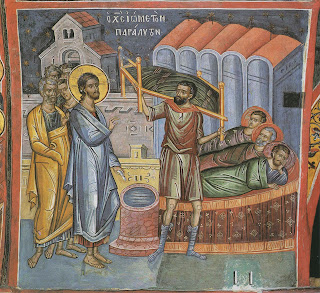
In the fourth chapter of John, we saw in Jesus the personification of God's justice as mercy in response to wisdom, the bearer of truth.  John 5 reveals Jesus as God's righteous judge. This theological understanding of God's justice is presented in the context of the story of the paralytic man who had been placed by the pool called Bethesda in Jerusalem.  According to some early versions of John, the waters of the pool were occasionally stirred by an angel of God and when this occurred whoever made it first into the pool at that time would be healed.  What starts out as one of several healing miracles of Jesus found in the gospels contains the Bethesdian Dilemma.

BIBLICAL NUMEROLOGY

Numbers possess coded meanings in Bible.  This is particularly true in the Gospel of John.  The purpose of numerology is not to convey a sense of mystery but rather it is used like shorthand to provide information without having to use costly ink and papyrus to explain something.  It served an economic purpose.  Times, amounts, ages, and any use of numbers deserves close scrutiny when reading the Bible.  There is usually a meaning attached to it that hints or suggests some background information the author is getting at as we will see in the story of the paralytic man.

For instance, the number five comes into play in the mention of the five covered pillars which identifies the place as Bethesda.  Bethesda comes from the Hebrew words beth, meaning house, and hesed, meaning mercy. As noted in my previous post, the number five is the numerological symbol for mercy, sometimes identified as grace.  The five covered pillars become the house of mercy. Invalids of various kinds were brought here, which suggests it served as some sort of care center. The notion of an angel stirring the waters has been, in some translations or versions, eliminated.  This information was assigned to verse four of this chapter.  If your Bible does not mention an angel, check the verse numbering in this chapter.  In most translations without this account, the verse numbering goes from verse three to verse five.  There is no verse four.

MERCY

It is unknown what level of care was given, but the suggestion is that family or friends would have been the main care providers, as the paralytic in this story points out he had neither to help him into the pool. The notion of mercy implies more than compassion.  Mercy,  as we observed in chapter four, is shown to the undeserving. Mercy involves judgement and a willful suspension of justice.  Chronic illness or disability; the type seen in this story, was largely viewed as a result of sin in the middle east of the ancient world. The sin was either the result of something done by the suffering person or by some member of the suffering person's immediate family.  It was seen as punishment, an act of God's justice. The mercy most likely shown in the case of Bethesda would have been by those who passed by in the form of alms, food, or some other form of care.  There is very little information as to how these individuals managed to exist or subsist, which brings us to the story of the paralytic.

THE STORY


Jesus is entering Jerusalem via the Sheep's Gate. [Jesus is, as John will point out, the Good Shepherd.  The editors do not miss a beat at drumming home a point.] The reason Jesus is in Jerusalem is because of a feast.  What is interesting is that the editors don't bother telling us what feast he was observing.  It obviously was not important but served as the reason to get Jesus in the city to tell this story.  There are some oddities about this story.  The first is that Jesus and his disciples are traveling on the Sabbath day, the day of rest.  The authors of this story are making a point about Jesus' divine nature.  The Sabbath day is also the seventh day, not only a day rest, but numerologically it represents God's word, God's completed acts.  So Jesus walking about, carrying on as usual on the Sabbath,  becomes a symbolic reference to his divine nature and parentage which Jesus will reference later on in this chapter.

The paralytic man appears not have been totally paralyzed.  It is apparent that he could attempt to get himself to the pool, perhaps using his arms to pull himself there when the waters were stirring.  The length of this man's illness was 38 years.  The number 38 is not numerologically significant by itself, but I would suggest it is code for the number's combined value, 3+8 =11 which is significant. The number 10 in biblical numerology stands for the law and orderliness (the Ten Commandments , for example). The number 11, on the other hand, symbolizes chaos, disorder, excess, lawbreaking, and judgement. We also encountered the number 11 in the story of Samaritan woman who had five husbands and was living with a sixth male which the combined numbers make 11.  In her case, she was wise to admit and accept the message of Jesus.  In this story there is a much different outcome. 

[Note: In the icon I chose for this post you will see the number 11 in several places. I'm not sure that is what the artist had in mind, but I couldn't help but notice its abundant presence in this piece.]

According to this story, Jesus deliberately makes an effort to stop at this pool and chooses to heal this particular paralytic. There is no mention of his paying attention to anyone else or that he is moved by compassion at seeing the suffering that is all about him.   Again this is a story, a parable about Jesus, so such details are irrelevant from the authors and editors point of view.  What is relevant is that this healing story is not an unconditional healing.  Rather it is a story of healing as a show of mercy given by a judge.  In fact, Jesus asks the man if he wants to be healed.  You would think this would be a no-brainer, but the authors are being deliberate in having Jesus ask this question.

THE BETHESDIAN DILEMMA

There are probably several ways to interpret Jesus asking this question.  Given what I've already said about this individual, especially the coded significance of his age, his particular paralysis is depicted as the result of something he did - some sin.  There is a sense that he deserves what has happened to him. There is  also a hint of egocentrism that creeps into to this man saying he cannot get to the pool in time. He says he has no one to put him in the pool and cannot get himself there in time. On the surface this is tragic and we are prone to feel sorry for him, but there is something amiss in the way this man describes his situation.

Is it that he literally has no ability to get into the pool and needs total assistance but does not ask for help?

Is he too proud to ask for help?

No one helping this man for 38 years would also beg the question of John's audience at the time:  "What did this man do that others refuse to show him mercy?" He must have done something  tremendously egregious to be such an ignored, tragic figure.

It may be that he suffers from a narrow religious perspective; that he is too accepting of his fate, that he wallows in his condition and is somewhat comfortable with his misery. If so, he's as much (or more) a prisoner of his religious beliefs about his paralysis  than to the paralysis itself.  He is in some sense spiritually paralyzed, and this seems to be the point that is being made by the authors about this man.  So Jesus makes of it a simple choice on this man's part, he simply asks him "Do you want to be healed?"

Notably, the man does not give a direct answer but rather offers an excuse as to why he hasn't been healed.  So Jesus makes it even simpler. He tells the man to get up and [here's the clincher] to take (carry) his bed and walk.  And the man does just that.

The dilemma the man is faced with is that, in getting up and (more importantly) carrying his bed, he is violating the  prohibition against working on the Sabbath.   What strikes me as odd is that Jesus, knowing it is the Sabbath, knows the prohibition against working and tells the man to carry his bed. Why not just tell the man to get up and walk?  Why carry his bed?  In John, there is a capricious side to Jesus that is used to warn the readers to not take Jesus lightly:  Grace and mercy are not to be toyed with or taken for granted.

I would suggest there is an agenda at play in the way this story is being told. The reason for this story's appearance in John is to provide John's authors and editors a reason to have Jesus talk about his divine nature and his mandate as judge of the earth.  A secondary agenda is to provide a written polemic against what John depicts as a distortion of God's law and idolatrous adherence to the written word by the "Jews" which, according to John, they misunderstand.

In the story, once the "Jews" see the healed paralytic walking about carrying his bed their first concern is not that the man has been miraculously healed but rather that he is carrying his is bed on the Sabbath.  The presumed reason why he is being questioned by the "Jews" is that he went to the Temple to declare his wholeness. We can assume this because Jesus later catches up with him in the Temple.   The "Jews" are most likely priests, in this case.  As bothered as they are that this man is carrying his bed, they are more bothered that someone had the audacity to heal him on the Sabbath and ask the healed paralytic who did such a thing.   The man said he didn't know who healed him and the story says he didn't know because Jesus slipped into the crowd.  What is implied is that the man does not try to follow Jesus, to thank Jesus, but goes his own way and follows the Law by showing himself to the temple authorities.  In the other gospels, Jesus would have instructed the man to do so, but Jesus "slipping away" is used as code for the reader to seek the one showing mercy; to seek Jesus.

As the story continues, Jesus meets up with the man in the Temple and affirms the obvious that man is healed. It is interesting that many modern editors have added exclamation marks after this, as if Jesus is excited for the man.  It may be that Jesus was pleased for the man, but John's version of Jesus is not of a person who gets excited, and what Jesus says next seems to confirm the serious intent of this meeting.  Jesus tells the man to sin no more, less he risks something worse happening to him.

What could be possibly worse than paralysis, unless it would be judged for something against God, himself.   And that is precisely the dilemma this man finds himself in.  The question is what would offend God more, turning Jesus into the Temple authorities or saying nothing to them. The man does not know who Jesus is, even after being healed by him.  He knows the Temple authorities.  The implied question is whether this man committed a greater sin by telling the Temple authorities who Jesus is.

John doesn't have to answer the question directly.  That he commits a greater offence in turning Jesus in to the authorities has been implied throughout the story.  In John, the authors and editors exploit Jesus as being God's Only-begotten Son; in that, everything Jesus does is purposeful, even if what he does exploits situations or people to prove the point being made by these authors and editors.

After the healed paralytic man tells the Temple authorities who Jesus is, he is no longer needed in the story.  We are left with the disturbing thought that his fate was worse for having been healed by Jesus; that he feared religious authority rather than than show gratitude for God's mercy. He expresses no gratitude towards Jesus. He tells the authorities that it is Jesus who healed him.   The fate of this man is not a concern by the  authors and editors. It's a story that gets them to the point they want to make about Jesus and the Temple (Jewish) authorities. The story basically ends with the editors explaining that healing, working on the Sabbath, is why the "Jews" persecuted Jesus.  In fact John quotes Jesus  answering yet another unspoken question, "My Father is working until now, and I am working."

EQUALITY WITH GOD

The authors and editors have Jesus give one of many soliloquies on himself in John. Presumably, Jesus is addressing the Temple authorities in this soliloquy in which he claim to be equal to God the Father, which John points out is why the "Jews" persecute Jesus (which is to say that is why the  traditional Jews of the day were persecuting Jewish Christians by kicking them out of their synagogues). There is strong reference to salvation theology in this chapter, of Jesus giving life to whom he will.  Again salvation is not universal in John.  It's a matter of divine selection.  Jesus claims he can do nothing apart from the Father and the Father has turned all judgment over to him.

THE DISPASSIONATE JUSTICE OF JESUS IN JOHN

Unlike John 4, John 5 is less merciful in judgment or perhaps, better said, clarifies what mercy means.  In John 5 we learn that mercy is shown only to those who believe in Jesus, that he is God's only-begotten, and is the saviour of those who believe.  Mercy, after all, is an act of judgement.

Belief, in John,  must be understood as intellectual assent rather than faith.  It is perhaps the Gospel of John where the confusion over use of the word pistis originates, and it is the Letter of James that addresses the Johannine theological perspective rather than the Pauline perspective where faith is seen as action and motivation.  Faith as belief is stagnant, but that is what Johannine theology indicates it to be. Faith, in John, is not a matter of action, choice or motivation, but a matter of intellectual assent bestowed to those who are chosen. In other words, according to John if you are a Christian you have been chosen and the only free choice left is to the ability to reject being chosen.

This is the dilemma that John poses throughout its gospel.  The only choice a believer has is not to believe and by extension this forms the basis for John's polemic against Judaic Jews.  They were the chosen people who chose not to believe in Jesus as God's only-begotten Son even though, according to John, their own scriptures should have clued them in to who Jesus is.

John has Jesus telling the Judaic community, via his diatribe against the Temple authorities, that they are worshipping their scriptures rather than God; worshipping their laws to point of their own damnation, as illustrated in the story of healed paralytic; that they do not love God and do not (cannot?) understand their own scriptures.  In the end, there is no mercy being shown to those who do not believe, and Jesus can't help them because he must do the will of his Father. 

With this story John ends the discussion on the initiation rite of Baptism.  It is notable that the paralytic has resided by the water that could have renewed him for 38 years and presses no one to help him.  It is notable that when offered living water, in the person of Jesus, he shows no inclination of wanting to be healed and no gratitude for being healed or being granted a new lease on life. Again, John the Baptist is referenced to lend credibility to this perspective as a means to remove any nagging doubts amongst this gospel's audience.  The story serves as a final warning to those who have been baptized, not to take God's mercy lightly.

In chapter six John moves to a discussion on Holy Communion. 


Until next time, stay faithful.


Tuesday, May 31, 2016

MERCY AND TRUTH - Johannine Theology Part IV


 Mercy and truth are met together; righteousness and peace have kissed each other.
Truth shall spring out of the earth; and righteousness shall look down from heaven.
Psalm 85: 10 & 11


As I have mentioned in past posts, the authors or editors of John were deliberate in both their choices of what stories to include and in the creation and the formation of said stories.  Some are familiar and found in the synoptic gospels, others are unique to the Gospel of John. The story of the Samaritan Woman and Jesus is unique to John and is metaphorical and dependent on symbolism in order to highlight the theological messages it contains.  So before taking a look at the story itself, it would be  advantageous to examine some of these elements that are tucked into this story:

JOHN 4 - The Samaritan Woman and Jesus

For the purpose of telling the story of the Samaritan woman and Jesus, the authors and editors needed to get Jesus into Samaria from Jerusalem.  Their pretext for doing so is that Jesus's disciple are baptizing more people than John the Baptist's disciples were, and, for some reason, this caught the attention of the Pharisees which, for another unknown reason, prompted Jesus to head back to his home turf in Galilee.  It doesn't make a lot sense, but possibly clues us to the likelihood that the followers of John the Baptist, in the last part of the first century, were associated with Pharisees and prone to stick with traditional Judaism or likely denied the divinity of Jesus.  As such, the editors of John are once again making the case that John the Baptist was a follower of Jesus who proclaimed him to be the only-begotten son of God,  and that John the Baptist's followers should follow John's lead and become followers of Jesus like John the Baptist.  


THE ALETHEIATOKOS - The Bearer of Truth

The role of women in John is noteworthy.  Women play a prominent role in this more than in any of the other gospels.  What I would offer for consideration is that John utilizes a very ancient and intuitive insight which portrays wisdom, anthropomorphically, as a woman - as Sophia.
So I want to use this post to consider, in part,  John's portrayal of women as an image of  wisdom which bears or reveals a subject important to the editors of John - Truth - and to suggest that the feminine presence in John is code for wisdom that apprehends and bears witness to the truth, that is personified in Jesus.  This is not about the Theotokos that is frequently associated with Jesus' mother, Mary, but rather wisdom as Aletheiatokos, the bearer of truth.  Wisdom and truth are closely linked and both are feminine constructs in the ancient world.

In this story wisdom reveals the face of truth.  Truth inevitably is something that is revealed or discerned through an encounter of some kind. I chose the icon for this post because in the ancient world; particularly the Hellenistic word, a woman carrying a water jar would not have been lost one anyone. She's the Aquarian symbol, wisdom, the bearer of truth.  Truth is fluid and can only be contained by those wise enough to bear it.  The vessel is that which pours out truth which shapes and nourishes understanding.

What this story makes an obvious point about is that truth is not only apprehended and revealed by a woman, but by a Samaritan woman, who for all practical purposes is living "in sin."  This another theme that Johannine theology stresses; that it is the the sinner, the ones who know his or her sinfulness, who are the most perceptive and receptive of truth. In John most of this type is portrayed as a woman as the symbol of the type of wisdom capable of bearing the truth.


GOD'S REALM OF CHOSEN INDIVIDUALS

This particular story, unlike others in John, depicts an inclusiveness and universality based on individual rather than cultural  or tribal worth.  This is a foundational understanding that significantly differentiates Christianity from Judaism and Islam.  In Christianity it is the individual that counts and is responsible to God alone, as opposed to the community or culture to which the individual belongs. This differentiation will be made clearer in my next post on John 5.   I would suggest this is also why the Gospel of John stresses the notion of individuals who are chosen by God to be part of this new creative order, as opposed to Pauline theology, we keeps the door open for Jews, as God's chosen people, to always be included in God's new realm.

In Johannine theology, it is not where you come from or what cultural heritage or your parentage or what your community is that matters, it is who you are, as an individual, known only by God and chosen by God to be a child of light; chosen from the nation's of the world to be God's new kingdom, a new spiritual realm.  This gives the Gospel of John it's Gnostic hue and hints at Christianity's association with ancient mystery cults; namely, one cannot tell by outward association who is or is not a child of light.  It is known only to God.  The new creation in the resurrected Christ  is composed of individuals selected from the vast array of humankind who have been given (graced with) the ability to be born(initiated) anew.  In this sense Johannine theology dovetails with Pauline theology in which "There is neither Jew nor Greek, male nor female, slave or freeman."

THE STORY

This story begins with Jesus being thirsty.  It's the sixth hour, about noon. Since the use of numbers play a significant role in John, it is tempting to see symbolic significance in the time mentioned; as in,  it was from the sixth to the ninth hour that darkness covered the earth as Jesus' poured out his life.  This may have been in the mind of the editors, but since John's account of the crucifixion does not make much of the timing of events within the John's account of the crucifixion, I'm inclined to think the authors and editors were making the case that Jesus was merely thirsty or was using the time and hunger as a pretense or as a means to have Jesus send his disciples on an errand to get them out of the way for awhile,  So Jesus sends the disciples into the village of Sychar to find food and Jesus sits by the local well outside the village - Jacob's well to be exact.  Again, the story is making a point to John's audience, which there have always been others who have a claim to the covenant made with Abraham and his descendants.  There is an  intentionality in having Jesus wait for the woman in this story to approach.  Mercy involves patience and mercy patiently waits. Mercy is also a knowing act, a willful act.

So what does Jesus know?

Jesus knows that whoever comes to this well will, more than likely, be a Samaritan; someone despised by Jews; someone who Jesus, being  Jew, should also despise.  Jesus also knows that this Samaritan will likely be a woman.  Jesus also is aware that men don't talk to women in public and is one of the reasons he doesn't want his zealous disciples creating unnecessary waves. It's risky business after all. This is the middle east. Beyond that, Jesus will also reveal that he knows details about this woman's personal life.

One could merely assign such foreknowledge to an ancient belief that the divine always knows, is omniscient, and thus is in control or possesses the ability to manipulate  mere mortals into acting as desired. This is a possibility in John. Jesus is certainly portrayed as being very much in control of things, as the Johannine theological perspective is shaped by an apocalyptic and eschatological mindset which views reality as a paradox of all things accomplished eternally in Christ and yet unfolding on this side of life.  In other words, we currently find ourselves as living our lives indeterminately in a determined universe.

So when a Samaritan woman comes to the well, this is no surprise. What is surprising is that Jesus speaks to her at all and, even more surprising, he asks or demands a drink of water from her.  Beyond the risk Jesus takes is the even more surprising risk the Samaritan woman takes in not only responding to Jesus but also in challenging Jesus.

But this is a story.

It's not trying to make a point about proper social conduct or the rights of women in the first century middle east.  Rather, in John, the shock value is in the display of God's complete ownership of all creation in God's countermanding, at will, any and all social conventions of the time - another theme found in John.

I'm not convinced that the editors of John were thinking in those exact terms, but John and Christianity as a whole has this undercurrent running through them, and the story of the Samaritan woman exemplifies this theological position.

GOD'S RESTORATIVE JUSTICE

Beyond the highly theological perspectives that can be garnered from this story, there resides in its telling a deeply intimate and personal message that speaks to the individual listener:

"God knows you, personally; especially if you have been chosen to be part of God's realm. You are not just something that is overlooked or disregarded as unimportant by God. It matters who you are or what your situation in life is."

What we encounter is the prototype of restorative justice, as God's justice; as in, mercy seeking truth. What is perhaps most shocking about this story to the listeners of the day is that this woman is alive at all after having five husbands and living with a sixth man. Numerically speaking, or numerologically speaking, the number five is used symbolically to stand for God's grace or mercy, but the number six is used to stand for human weakness.  The suggestion of "living with a sixth man" suggests that having had five husbands was not the result of having lost five husbands due to death, but rather the misfortune of having her being divorced by them for what we might assume is her brash attitude or for her penchant for catching the eye of the "other guys" once she was married. The authors and editors of John were well aware that such a suggestion would readily come to mind of this gospel's audience without having to spell it out for them. Suggestion is part of the art of good storytelling.  [Note:  I will discuss the role of numerology in the Gospel of John in my next post.]

In the culture of the time and place she lived in she would have likely been accused of adultery at some point and put to death. When Jesus reveals the facts of her marital/sex life, however, she doesn't flinch from it but readily admits its factualness, which reveals her as the wise person or the personification of wisdom she is.

I have deliberately jumped ahead in the storyline to get at the pretext or what one might call a prequel that follows the main storyline which is aimed as depicting Jesus as God's truth.

It might be presumptuous to say that the author of this story deliberately has Jesus feigning thirst to get at the point of this story which is to depict Jesus as the living water of truth.  I would suggest that Jesus's thirst is a thirst to show mercy and be merciful so that the truth of God is revealed.

WATER, TRUTH, LIFE

Once again the image of water is used in John as a metaphor. In this case, water is a metaphor for truth. In the conversation between Jesus and this Samaritan woman, the exchange begins with the woman asking/challenging Jesus with the question why he, a Jew, would ask her, a Samaritan, for a drink.  In typical Johannine style, Jesus doesn't answer her question but responds  by telling her that if she knew who was asking her for a drink she would be asking him for a drink.  Like Nicodemus in John 3, the Samaritan woman seems puzzled by the illogical response Jesus gave - "How can you give me a drink," she asks, "You have nothing to get water with and the well is deep."  It is easy to gloss over her question as a simple observation, but being metaphorical presentation of wisdom, her comment on the depth of the well forces the listener to conjure up an image of darkness and mystery about the source of this life giving substance.

Jesus makes his point by telling that the water he has offer will become a spring, welling up inside to offer those who possess it eternal life. The woman immediately (and wisely) asks for such water. It is at this point Jesus moves to the conversation about her marital life as discussed above which, as I mentioned, serves as a pretext for revealing Jesus as the truth of God.   Jesus's exposure of her life story causes the woman to reveal that Jesus is a prophet and they enter into a conversation about worshipping God. The Samaritans have their own holy mountain and Jews have the temple. Jesus makes a rather arrogant comment about the Jews knowing what they worship and the Samaritans don't; that salvation comes from the Jews.  This seemingly arrogant/biased statement belies its deeper meaning that John's Jewish audience might have picked up.

Rabbi Jonathan Sacks, in his recent book, "Not in God's Name," pointed out that the Jews, being God's chosen people, meant that they are given a great responsibility not only to God but to the world as the means through which God will save humanity from itself.  What these Johannine scholars are reminding the audience of their day is that the Sadducees and  Pharisees of their day had dropped the ball, became a thing into themselves, and God had placed all authority in the one faithful Jew, his only-begotten son, Jesus.

 In the story John has Jesus telling the woman that there will come a time when true worship of God will take place in neither place, but rather true worship of God will be in spirit and in truth. This is a very loaded statement that deserves deeper reflection. On the surface and for the purpose of this post, I will say the authors and editors of John employ it to affirm to their audience of the time that since the destruction of the temple, they are such worshippers, that Jesus's prediction in the story came true.

AN INTIMATE REVELATION

The woman states that she is waiting for the Messiah, and this becomes the first time in the Gospels that Jesus openly says to a person and confirms that he is the Messiah.  The shock value of this is, that until now in John, he has not admitted this to his disciples or to anyone else.  It is to this unnamed Samaritan woman who had five husbands and living with a man who he reveals the truth about himself.

This is one of the most detailed and intimate exchanges recorded in the Gospels between Jesus and another person. It is a story that employs a conversation that reveals a sensual trust - a sensual (deeply intuitive and deeply felt/perceived) relationship between the personified representations of mercy as God's righteous truth in Jesus and wisdom, the bearer of God's righteous truth in the person of the Samaritan woman.

In the story, I found it interesting and perhaps significant that the woman leaves her jar at the well as she becomes the jar, the vessel, the Aletheiatokos that bears/contains the life-giving water, the truth of Jesus to her fellow Samaritans in Sychar of whom most are receptive and accept Jesus as the Messiah.

* * * * * * * * * *

Chapter four ends with another short story about Jesus healing an official's sick son in Capernaum without going to see the son - a story that reaffirms Jesus's merciful nature and long reaching compassion for all who seek his truth. It also serves the purpose this gospel's editors practice of providing extra proof of Jesus's divine nature.  

In further chapters of John one encounters a more pedantic approach on the part of Jesus to the themes found in these first four chapters.


Until next time, stay faithful.


Tuesday, April 26, 2016

CONVERSING IN THE DARK - Johannine Theology Part III

I
Note:  All scriptural citations in this post are taken from The Holy Bible, New International Version 1984 by the International Bible Society
JOHN 3
Perhaps the most challenging chapter in the Gospel of John is the third chapter, the encounter between Nicodemus and Jesus.  Chapters one and two of John set stage for the rest of John's Gospel by making it clear that Jesus is the only begotten Son of God and the Jesus is also the Lamb of God who offers himself as the blood sacrifice, the new Passover lamb, whose blood will be spent to save those who are his own - those who are called and chosen by God.  The implication in John is clear - some make it  into God's kingdom, others don't.  This is not only unsavory - It is wrong.  In my opinion, this conclusion of John 3 renders it unworthy of the papyrus it was written on and here's why...

Chapter three is a recap of the message chapters one and two is making just in case you haven't figured it out.  In chapter three we see Jesus testifying about himself to a person only mentioned in the Gospel of John, Nicodemus.

Nicodemus is thought to be a Pharisee who was also a member of the Sanhedrin, the Jewish ruling council.  He doesn't play much of a role, being mentioned on three different occasions in John; here in the cover of darkness, the second time at Jesus's trial before the Sanhedrin and the third time is mentioned as the one who purchases the spices for Jesus's burial.  The significance of Nicodemus may be lost on us.  Undoubtedly mention of him in John lends a sense of gravitas to what the authors of John are trying to convey.

If one were to follow the storyline of John, one is led to consider that Nicodemus comes in the cover of darkness presumably because Jesus has earned himself the reputation as a trouble maker in the Temple [see John 2] and Nicodemus, being an official of the Temple, doesn't want to be seen conversing with a rabble rouser.  Darkness is also the condition Nicodemus finds himself in. He is intrigued by Jesus but is not able to figure Jesus out.  The impression is that he wants to know more. The darkness is symbolic of his unknowing.   There is a sense in John 3 that Nicodemus could also represent those being initiated into the mystery of the Christ.  He is in some way our guide into this mystery.  The thought has occurred that Nicodemus might have been originally intended to be the one who is telling the story Jesus in John, but then was relegated to play a much lesser role.

As an initiate, Nicodemus is faced with a  quandary posed by Jesus that takes on a riddle-like quality.  In fact, if this were a factual story, which it is not,  we really have no idea why Nicodemus was approaching Jesus based on anything Nicodemus says.  Nicodemus does not even ask a question but rather makes a statement that no one could do the miracles that Jesus had done unless he came from God.  That's as far as Nicodemus gets and that's the point the authors and editors want us to get from Nicodemus - Recognition that Jesus comes from God.

Jesus, as portrayed in John, rarely gives a direct answer or response to anyone's questions or statements. Before Nicodemus has a chance to ask a question, Jesus is giving an answer.   The answer actually shapes the question that Nicodemus doesn't ask, but which the authors and editors of John want the reader or listener to ask.  The trouble is that most Christians are so indoctrinated how to think about this chapter that very little thought is actually given to it.  So let's do some unpacking.

BORN AGAIN

Being born is code for being spiritually remade or reshaped by God's Spirit as a new spiritual creature.   Once again John is rewriting the Genesis creation story.  This is something that Paul also talked about in his epistles. Early Christians saw the resurrection as the genesis point of a new creation in Christ.  By the time John is being written this was or was becoming standard Christian theology. In this sense, some evangelicals and fundamentalists are very much in line with Johannine theology.  There is a quasi-intellectualism about this process as explained by Jesus in John; that no one can see the kingdom of God unless one is born again, or to put in language of the time, one has to be initiated into the mystery of Christ to gain spiritual sight.  Initiation rites were a big thing at the time of Roman Empire - so many cults had such rites.  This would have been easily identifiable to John's audience at the time and readily accepted as proper procedure.

Nicodemus plays the straight man, the literalist, who questions Jesus how a man can be born again at his age. His role in this chapter is to be the fall guy who asks the question everyone is thinking about.  Of course, true to John's form, Jesus continues being enigmatic about the whole thing.  His answer is basically another riddle:  "No one can enter the kingdom of God unless he is born of water and the Spirit (code for the initiation rite of Baptism). Flesh gives birth to flesh, but the Spirit gives birth to spirit.  'You must be born again."   To further mystify the issue Jesus adds, "The winds blows where it pleases.  You hear its sound, but you cannot tell where it comes from or where it is going.  So it is with everyone born of the Spirit."

Hmm... What's John's point in having Jesus say this?

There is an unspoken or subliminal question that John's authors are trying to answer.  It's a question that has plagued Christianity from its inception. If Jesus died on the cross to save the world from its sins, to pay the wages of sin, why is there sin in the world and why is the world the same as it was prior to Jesus' death and resurrection?  What has changed?

THE SPIRIT

In the book of  Genesis, it was God who breathed "his" spirit and made mankind in his image.  The authors of John are putting a twist on this.  Since the feast of Pentecost, God's Spirit has gone rogue and recreating the world one person at a time, "The wind blows wherever it pleases."    The force of the Spirit drives those who have been reshaped, reborn, recreated by the Spirit to wherever the Spirit desires.  In John's creation story, the Spirit of God is once again the active force that is making followers of Jesus and has Jesus telling us so himself.

When Nicodemus asks, "How can this be?  John's authors are answering  a question that was being indirectly poised to rabbinical community of which Nicodemus is a symbol of.   The answer Jesus gives in John is to this community, "You are Israel's teacher (code for rabbis) and do you not understand these things?"

Jesus basically let's Nicodemus' question, the rabbinical question, drop by saying, "I have spoke to you of earthly things and you do not believe, how then will you believe if I speak of heavenly things?"   I'm not sure what "earthly things" Jesus was referencing, but in essence what John is having Jesus say, if you can't get it, can't see it, I can't help you, but I will give you clue anyway. Jesus then goes on to say the sign that they already have regarding God's act of salvation in Christ is what happened in the wilderness when Moses raised a snake on a cross like structure so that everyone who saw it would be saved - another riddle?  The oddity in this is that the authors of John are engaging in the redactive practice of reading a meaning into a past event and then putting it into Jesus' mouth as a prophecy about his yet to be death [if one were to read John as a linear story about Jesus, which it is not].

JESUS' ODD SOLILOQUY

Perhaps the oddest soliloquy ever written is John 3:16 through 21, the famous "For God so loved the world" passage.  It would be a less odd soliloquy if it were said about Jesus by Nicodemus, since he was present at the time or, better yet, if it found its way into one of the letters attributed to John about Jesus.  If that were the case, it would have made sense, but John 3: 16 through 21 has Jesus talking about himself as if he were in the third person and uses the past tense to explain the supposed present and intimated future tense; as in, "For God so loved the world that he gave his one and only Son, that whoever believes in him shall not perish, but have eternal life."

Is this some form of a first century attempt at rhetorical or literary modesty on Jesus' part, by not referencing himself in the first person? 

Talking about one's self in the third person tends to heighten not lessen the narcissistic tone that John 3:16 presents Jesus as having.  I doubt that people in the first century would have seen it differently, and it has become (at least for me) one of the key verses in John which has convinced me that this entire gospel is a story or a parable about Jesus made to appear as though Jesus said the things attributed to him in it.

Another possibility is that John 3:16 -21 is a theological commentary made by the authors or editors of John in an attempt to explain what Jesus was talking about and connecting it to chapter one.  The original Greek text did not use quotation marks or red letters to let one know when Jesus was speaking.  The only reason to think this is Jesus talking comes from verse 10 which simply says , "and Jesus said," after which there is no interruption to the comments being made to indicate it's an insertion beyond the grammatical use of person and tense.

Having said that, I need to get back on track about why this is said.  The purpose of having Jesus give this soliloquy is to answer the unspoken question - why the world hasn't changed?  Here John gives a nod to the original creation story in this soliloquy.  The implication in John 3:16 is clear - God loves the world - the world he created - God's original creation as described in Genesis.  This is the tenuous link John maintains with Judaism - that and reading everything in Hebrew Scriptures as a foreshadowing of God's realized intention of saving the world by sending Jesus into the world as his only begotten Son - an intent that was a given from the very beginning of world - a sort of "just-in-case" measure  things go south, which they did rather quickly in Genesis.

EVERLASTING LIFE

Now if God loved his original creation, God's remake of that creation from those chosen to become believers in Jesus is, according to John, even better.  Since Jesus paid the ultimate wage for the sins of the world, death, and God accepted it by the sign of Jesus' resurrection (implied at this stage in John) they will have everlasting life - if not in this life - then in the life to come.  I would add that if this were a literal retelling of Jesus' actual message during his life time, it would have made absolutely no sense to anyone who heard it.  This whole passage is written on the presumption that everyone who is listening to this gospel knows Jesus' story.  That is the only way this passage makes any sense. 

As to the reason the world continues to be what it always has been, sinful, is that God will not destroy what God has created.  Jesus is not sent to destroy or condemn the world but rather to save it, one believer at a time.  This, of course, creates a theological conundrum that remains unexplained:  If Jesus died to pay the wages of sin for the whole of humankind, why isn't the whole of humankind saved and given eternal life?

Progressive Christian theologians tend to say today that ultimately this is exactly God's plan and intent - everyone is ultimately brought into God's new creation and saved, which I see as an evolving intuition based on the New Testament theology as a whole, but John stops short of that in verses eighteen and nineteen.  John tells us that that whoever believes in  Jesus will not be condemned and those who don't are condemned already.

Already?

THE LIVING AND THE WALKING DEAD

John's vision of reality is dualistic.  There are people of light and those in the dark.  There are those who believe and those who don't.  There are those who are saved and those who are condemned even as Jesus is speaking.  This is the version of reality the authors of John are expressing when John was being written.   Things are what they are.  It's a version of reality that has much appeal today.  It's a literal example of black and white thinking.

The implication in John 3 is that God cannot destroy God's original creation, as in the covenant made with Noah, by which John means humanity. At any rate, it will self destruct eventually; such is the apocalyptic understanding promoted by Johannine school.  God has selected those who seek the light to be saved and those who don't cannot be saved, as if to say God will not violate the concept of human choice or will.  This throws out any notion of universal salvation.  It is also extremely problematic from both a human and theological perspective.

The "already" comment about the condemned paints a hopeless picture.  They are as good as dead upon taking their first breath.  They are no more than zombies, the walking dead.  In my opinion, the authors and editors of John overplayed their hand when they got into this quagmire.

I believe their intent was to discourage the audience of their time from listening to or conversing with those who disagreed with them; namely, the Pharisees who would not have accepted Jesus as divine, much less, God's only-begotten son. I believe discouraging association with the Jewish community to be their intent given the fact that the Pharisees and the Jews are consistently portrayed negatively throughout this gospel.

This approach would have had pragmatic implications as well, since the  fall of Jerusalem and the destruction of the Temple in 70 CE.  Christians were having a rough time as it were, Jewish communities even more so.  Christianity literally, in some places like Rome, started to go underground.  In others they figuratively did.  With the destruction of the Temple, the visual heart of the then Jewish world was destroyed.  This was likely understood by Johannine school as the death knell of Judaism and confirmation of their view of Jesus as God's Son and why John begins with Jesus cleansing the temple.

John doesn't stop with Jesus making his own claim of being God's only begotten son.  John once again brings John the Baptist back on stage to reaffirm what Jesus just said about himself.  Again there is an unspoken issue being addressed by having John the Baptist saying in verse 30, "He (Jesus) must become greater; I must become less."  John the Baptist claims that all authority has been given to Jesus as God's only-begotten and ends by stating once again at the end of Chapter 3, "Whoever  believes in the Son has eternal life, but whoever rejects the Son will not see life, for God's wrath remains on him."  

WOW!  We get it, already!!

MAKING SENSE OF JOHN 3

There are several ways to view John 3.  One thought that occurs is that it was part of another gospel that was edited into the Gospel of John - a gospel that might have used Nicodemus as the narrator.  There is a Gospel of Nicodemus that can be traced to Medieval era. This would have had to been a much earlier gospel.   In some ways John 3 reminds me of Genesis 1 and 2; two different but similar creation stories. 

Like the wedding of Cana, the Nicodemus story is parabolic in nature.  Nicodemus, in this chapter, appears used and abused.  His presence is functional to the extent that he allows John's authors to have Jesus say something about himself and to establish the importance of the initiation rite of baptism as necessary for salvation as the only means to being born again.  Nicodemus is also used to represent the rabbinical class, the teachers who don't get who Jesus is.    Later on, Nicodemus becomes the voice of reason and represents those who honor the sacrifice of Jesus on the cross. Throughout the centuries Nicodemus has been viewed as a saint in both the eastern and western churches of Christianity.

I mentioned that the authors, in their attempt to make a clean break from Judaism, overplayed their hand when it came to declaring that there are those who will be saved and those who are condemned "already."  Progressive theologians would just as soon gloss over verses 18 and 19 of John 3.  Those Christians who promote universal salvation; that all will be eventually be saved, have to deal with these verses. 

Personally, they make no sense to me as a human being and raise all sorts of theological problems about the Gospel of John, Jesus, and salvation theology as a whole.  Personally, I think the Gospel of John is wrong about Jesus and Chapter 3 proves it.  I can empathize with John's authors from a historical perspective as to why they portrayed Jesus as they do, but they get it wrong.

What appears to be a sophisticated approach to answering the question of who Jesus is becomes a bungling theological mess that most have sanitized by calling it mystery.   John 3 is not a mystery.  It is an editorial faux pas that is completely unnecessary to the story and meaning of Jesus' ministry.  It is, in a word, "overkill" and will taint the rest of John and has tainted Christianity as an excluding religion. 

In the establishment of Christianity as its own religion, one can appreciate the zeal these authors and editors possessed in writing and creating the Gospel of John.  By zeal, I do not mean to imply a lack of sincerity.  They were undoubtedly sincere in their beliefs about the meaning of Jesus they wanted to portray. In the polytheistic cosmopolitan environment in which they were defining this new religion, they understood the radical nature of what they were saying.  What I am saying here is not to question their sincere beliefs or diminish their endeavor. 

What I am saying is that Christianity has evolved from where they were and that is my primary point in discussing the Gospel of John, in particular.  In a world where atheism was tantamount to insanity, speaking of any form of God or gods came from the perspective of God's existing as separate, other beings, different from humans in any number of ways. Monotheism was a major shift in thinking about the divine and was a giant leap towards a singular view of religion - God is one.  Christianity brings this concept to earth in the form of Jesus which the writers of John attempt to meld together by imbuing Jesus with both the divine and human traits and declaring him to be God's only-begotten Son. 

This was an extremely radical view and led to Christians being accused of atheism by Roman authorities who understood the emperor to be the son of God.  From that perspective, John 3 is setting another agenda about who Jesus is - a defiant agenda against the earthly powers that be. The writers of John could not anticipate the changes that have taken place since their time.  They may very well have thought the world in which they lived would be the final version of reality; that it would come to an end very quickly - perhaps within their own life time.  Some Christians still think this way today.

In fact the world ending or the end of human life is today more of a scientific probability  than a religious belief.  The fact that we have scientific proof of the earth's vulnerability and the fragility of life, as a whole, on this planet has changed how many Christians view life on this side of death.  They are seeing it as far more precious and much less an obstacle to get through unscathed in order to obtain life on the other side. 

John 3 is a dangerous chapter in the New Testament; dangerous if not understood as a theological faux pas based on a world view at the time it was written.  It's a time piece whose time has come to be exposed for what it is - bad theology for the 21st century and for the foreseeable future.  In the ever evolving religious life of us human beings and of Christianity, in particular, we who are Christian have a responsibility to correct the errors of the past, not eliminate them, but rather own them and  understand them compassionately, explain them, and to revisit and, if necessary, to  reshape our understanding of all the traditions and beliefs that have been handed down to us. 

In some ways and in some parts of the Christian world this is happening, but much of it is happening by glossing over the unsavory parts of scripture rather than calling them for what they are and pointing out the flaws they present.  For me the practice of trying to sanitize a flaw is to perpetuate it.  A flaw is a flaw.  Point it out and fix it by telling why it is flawed.

Monotheists are hung up on their scriptures.  They have a tremendously difficult time calling things that are flawed and unsavory in their ancient scriptures as such.  They would rather gloss over them, call them a mystery, or not speak about them at all. 

Lectionaries are a wonderful means to ignore unsavory parts of scripture.  I have yet to hear a sermon or a homily that points out the error of an assigned reading for the day in clear, straightforward language, as in saying, "That was a waste of ink and papyrus and here's why... ."  It would be liberating and refreshing.

Until next time, stay faithful


Friday, April 15, 2016

SETTING THE STAGE - Johannine Theology Part II

THE GOSPEL ACCORDING TO ST. JOHN
In this and subsequent posts, I will examine the Gospel of John as a creative work of theology.  The Gospel of John has had many books and papers written about it.  I am not going to bother with attempting to explain what others have written.  I will examine this gospel, sections at a time, to point out some of the nuances I see in it.  The readers of this blog are invited to read the Gospel of John (hereafter referred to as John) along with me as I comment on it. My hope is to offer an objective understanding of this gospel as a work written during a particular time in which Christianity emerges as a new monotheistic religion.  

In this and other posts, I will be working from the premise that John is composite work involving more than one author and that it has been subjected to numerous editing throughout its dissemination within the early church.  As such, I will be referring to its authors and editors.

The Gospel of John assumes its audience has some knowledge about the life and times of Jesus; that is, enough knowledged to allow its authors to play around with timelines, storylines, and the characters found in the three synoptic gospels.  For instance, names appear out of the blue with little or no introduction as to what role they played in Jesus's life and ministry.  There is an assumption on the part of John's authors that their audience knows what and who they're talking about.

All of this lends support to the notion that the Gospel of John is theological work or perhaps, better said, an early doctrinal work on the meaning of Christ and the Eucharist.
Minutiae matters in John.  Most Christian readers gloss over it because they think they know the Jesus's story so well.  The Gospel of John turns most of what we think we know about Jesus on its head - especially when read in comparison with the synoptic gospels.

John 1

TO BEGIN WITH

John is written for an intellectual audience.  Given the premise that John's audience is  primarily Jewish, one can speculate that they were Hellenized Jews and that some of this audience were gentiles, particularly Greek, and well versed in Hellenized thought because the first verse of John is immersed in both Greek and Judaic logic. The point of the first chapter of John is to established the divinity of Jesus.

"In the beginning" is the exact phrase used at the beginning of Genesis.  Readers of the Septuagint [Greek translation of the Hebrew scriptures] would have understood the implications of what the authors were about to embark on.  In fact, the word for beginning in Greek is loaded.  It has, in modern-day parlance, a Big Bang quality about it.  It connotes a sense of power and can be literally translated as such.

"In the beginning was the Word."  The Greek word for "Word" is "Logos," another very loaded term, which connotes reason, logic, and in this case the act of saying or creating.  Its use supports the ancient monotheistic concept that God is a verb, God is acting, but John does not stop there, John's mission is to move from an indescribable, abstract construct for God to a very much flesh and blood one, a person, who will redeem or recreate creation with this simple phrase, "And the Word became flesh and dwelt among us... ."

Jesus in a very few lines is identified as the eternal Word through whom all things are made and then comes to be enfleshed as one of us to live in a redemptive relationship with us.  This is a seismic shift in theology.  To think of God becoming a human is beyond scandalous, it's heresy, at least to the Judaic mindset of the time.  Philosophically it raises ontological questions as to why God would do this and who's running the cosmic show while God's saving this speck of dust called Earth.  It will ultimately lead to the question what is the nature of God, but that's for a later discussion.  John's concern is to say that God is fully present in Christ Jesus who becomes God's enfleshed, only-begotten Son.

The creation story in John is notable for its lack of mentioning anything good about creation as frequently described in Genesis One.  In John, there are people who see the light and those who dwell in darkness.  John is setting the stage for the followers of Jesus to experience the intimacy of their relationship with Jesus by presenting the world as it is or thought to be at the time.  It's not all good. It's a mix. Into this mixed up world Jesus, the enfleshed only-begotten Son of God, comes to establish the kingdom of God.  John points out that there are people who will not accept Jesus, who do not know him, cannot recognize him.  The authors of John make it clear that it is near impossible for mere mortals to see the enfleshed God in Jesus unless one is called, one is chosen to see Jesus.

This theology is shaped by the real experience that there are and were those who cannot or refuse to accept the Johannine theology that Jesus is the only-begotten Son of God.  What John acknowledges is the counterintuitive nature of the gospel message.  The world beyond the confines of the ecclesia cannot grasp its message by itself, only those to whom it is revealed by God are capable of receiving it.  There is a Gnostic undercurrent in John.

The intent of John, however, is not to create anxiety over this lack of understanding or rejection exhibited in others, but rather to reassure John's  audience that there is a degree of intentionality about it all;  that there is a purpose in all of it and since the reader or listener is one of the blessed, one of those who has seen the light and receives Jesus as the Word, sonship awaits for those "born of the will of God" - the chosen few.

JOHN THE BAPTIST

The Johannine school of theology also makes an effort to clear away any confusion about who John the Baptist is.  There's an implied issue here.  Apparently there were those who considered John the Baptist to be the messiah.  The authors of John are intent on clearing this up and assigning John the Baptist the role of Jesus's forerunner and gives John the Baptist the honor of being the first, in John's gospel, to recognize Jesus for who he is.

An oddity in Chapters One and Two is the element of time.  We have a beginning that does not mention anything about time or days, as does Genesis One, but then when John starts talking about John the Baptist we suddenly have in verse 29 mention of a "next day" - as in the second day - when John the Baptist sees Jesus coming to him. 

What happened to the first day?

It is tempting to make something of a missing piece, to assign it a mystical meaning.   In this case what I think the lack of a mentioned first day points to is the composite nature of John; that it was pieced together by its authors or that mention of a first day was editorialized out of of the final script. Simply put, whatever happened to day one in the narrative about John the Baptist and/or Jesus is simply lost.  

What we have is a next day, a second day in which Jesus makes his first appearance as a real person doing real human things, like walking by John the Baptist as he is baptizing people in the Jordan.  What is a curious fact about this event is that Jesus is not baptized by John.  Jesus approaches John for the purpose of being declared by John the Baptist to be the "Lamb of God, who takes away the sin of the world."

There is no description of Jesus entering the river or being baptized.   Rather John the Baptist declares that the spirit of God is resting of Jesus and states that whereas he baptizes with water, Jesus will baptize with the Holy Spirit.   There is always an assumption by readers of John's gospel that Jesus is baptized by John the Baptist and, later on in the gospel, the assumption that Thomas actually puts his hands into the wounds of Jesus, even though John never says any of those  things happened. 

Why?

Sometimes things left unspoken in John serve as invitations for further contemplation.  This is what makes the Gospel of John more of a challenge and a difficult read.  In John's gospel, Jesus doesn't require the act of a  physical baptism to be declared the Lamb of God.  The Holy Spirit is already upon Jesus as the eternally begotten Son of God, enfleshed in human form.  Later, Thomas does not need to touch Jesus's wounds, he only needs to hear Jesus's voice, Jesus's word, and be recreated in his acknowledgement that Jesus is his Lord and God.  Words have power in John because the Word is the power of God. 

John goes on to talk about the calling of select group of disciples that come to Jesus in twos,  Andrew and Simon or Peter and Philip and Nathaniel - an odd selection.  The first two are rather familiar and the latter two not so much, the underlying message seems to be this: There are those who have actually seen Jesus, heard him talk and then there are those who are brought to Jesus by those who seen him first.

The interesting undertone is that both Simon and Nathaniel are the one who receive more comment and compliment from Jesus than the Andrew and Philip do.  What can one make of that?  The obvious meaning is that those who come late to Jesus are just as important, just as worthy, as those who originally knew and met Jesus.  Jesus comes to those who come to him and the promise is that there is more to come.    The obvious message in this vignette is that Jesus knows who he is calling. Disciples are chosen.  John's audience who receive the message are God's new Chosen People. 

The first chapter of John establishes several things about Jesus.  Jesus is the reason for creation, Jesus is God and, in the flesh, Jesus becomes the Only-begotten Son of God.  There are people who get this, like those who knew Jesus, such as, John the Baptist, Andrew, and Philip, and those who are seekers of Jesus, like Peter and those who are met by Jesus, like Nathaniel.  All proclaim Jesus to be the Christ, the Son of God   More importantly, according to John, one cannot get this message unless one is chosen by God; in that, God wills some to get it.  It's reflects the "many are called but few are chosen" scenario found in the Gospel of Matthew.

John 2


WEDDING WINE

Chapter 2 begins with " And  the third day...." and the story of the wedding at Cana.   I think this is a totally contrived story - a parable about Jesus - to set the stage for what is to come.  It's a story that has multiple layers or meanings, the least of which is that it has to do with a real time experience. 

The premise of the story is that the Jesus and his band of disciples along with his mother were at this wedding feast. We don't know whose wedding this was or if the person was a friend or relative of Jesus, but the implication that Jesus' mother was serving means the people involved were well known to Jesus, were his friends and relatives ( in coded language, the family of God, the ecclesia). The lack of detail is telling and clues us to the story's parabolic nature.  The use of a geographic location, Cana of Galilee, tends to lend credibility to its being a real time event, but I would suggest that the authors' intent is a double entendre, a parable with real time application, God at work in our world, our reality.  John is also pointing to the greater reality that John's audience is part of, the realm or kingdom of God.  John is notorious for use of  this approach in delivering a message to the listeners of the day.

The wedding feast  or feast is common theme of Jesus' parables in the synoptic gospels.  It plays a role in Pauline theology and it should not be a surprise that Jesus should be portrayed as performing his first "miracle" in John at a wedding in which Jesus and his disciples are participating in.  A wedding feast is code for the ecclesia, the Eucharistic feast.

Also, we have our first encounter with the fruit of the vine, wine. Wine is the literal life blood of the ancient Mediterranean world.  Running short if wine at a wedding might have been considered an embarrassment to the host. In the full context of this gospel, John uses this story metaphorically to hint that this wedding feast represents the depleted state of Judaism of which John's audience was a part of.  In the light of Christ, it's traditions and laws are the jars, and its jars are empty.  There is a very symbolic moment in this story when Jesus asks the servants to fill the jars with water. 

Water is associated with death in Judaic mindset and is a symbol of baptism. Baptism is an entry into the death of the old self.  It is used to clean the dead.  Jesus fills the jars with water which then become wine, and not just any wine, but the wine that will make you party hardy. Wine, new wine, is new life and new meaning.  This is a transformative moment, a moment of transition. Jesus injects new life into the party, offers the better wine of celebration, has taken the ordinary and transformed it into the extraordinary.   One could play with the various meanings of this story ad infinitum, another indication of its parabolic nature.
MARY

Leave it to the mother of faith, Mary, to come to the rescue. The jars are empty.   In the story, when the wine runs short, Jesus' mother, Mary, tells the servants (another term for believer) to do what he says and all will be well.  Jesus feigns being annoyed by being approached by his mother on what he views as a trite matter and complains that his time has not yet come - a phrase that will be repeated after his resurrection to another Mary [as mentioned earlier John has to be read as a whole or one will miss the clues to its coded message].  In other words, throughout John there is implied a hiddenness to who Jesus is; a not-yet or yet-to-be quality that is held in tension throughout the gospel.   It gives an esoteric quality to John, an unspoken question, "When will Jesus' time come?"  It provides an eschatological patina to the entire works attributed to John as found in the New Testament.

Jesus, compelled by his mother's intercession, turns ordinary water into wine - a wine that far exceeds the quality of the first wine.  The role of Mary as intercessor is undoubtedly established or is being established as doctrine by the time John is written.  Jesus becomes the ultimate host of the feast, the Eucharistic celebrant who changes the ordinary into the extraordinary.  Mary represents the faithful intercessor who is wise beyond knowing.

HOUSE CLEANING

The scene quickly shifts, not as a new day but to a new location.  It seems to me the editors of John make a rather shabby attempt at giving the narrative a linear feel as a means of giving it real time look.  The reality is that what John jumps to next is anything but in keeping with the timeline of events recorded in the synoptic gospels.  This too points to John being a theological commentary on who Jesus is.

We find Jesus and company in the Temple precinct just before the feast of the Passover.  Again, the reader is confronted with a not-quite-the-time or an anticipatory moment.  John uses these in between times to underscore a sense of preparation or a call for preparedness.  As noted before the authors of John assumes the reader has previous knowledge about Jesus.  There is no cogent reason why Jesus would drive those who were selling cattle and doves for sacrifice in the Temple precinct as stated in John.  One would have to possess some understanding as to what Jesus saw that would lead him to do something like that.  It's a violent act that places Jesus in an uncharacteristic light.  The reason Jesus gives for doing so in John is even more confusing, "How dare you turn my Father's house into a market."

First one has to understand that sacrifice was an essential function of the Temple.  How else were people to offer sacrifices if they could not purchase animals to do so? Of course, what is unspoken in John is that there was corruption in the selling business, especially with the money changers who gouged people for converting the imperial currency to temple currency.

None of this is mentioned in John, which leads one to conclude that either John's audience would have known all about this or they didn't and for John's purpose what matters is to get to the point of Jesus being asked by the "Jews" which, by the way, is the first time "Jew" is mentioned in as a differentiating comment which will increasingly be mentioned in a negative context,  for a sign of his authority.  Jesus responds, "Destroy this temple and I will raise it up in three days."   The "Jews" take him to mean the Temple there having this conversation in (and why wouldn't they?), so the authors want to make sure John's audience understand this is code for the resurrection, making the connection that he, Jesus, is the true temple of God, the indwelling presence of his heavenly father.

While John wants to get to the point about Jesus sending a coded message about his eventual death and resurrection, I can't help but be intrigued about John having Jesus complain about turning his Father's house into a market.  In fact, I see more application of this statement in today's world than any other found in these first two chapters, which brings me to the following: 

MAKING SENSE OF THIS TODAY

As many of you know, I'm not particularly fond of John as a gospel and some may be asking why spend so much time on it if I find it to be difficult and troublesome.  My answer is simply that John is what it is, a vital part of the Christian story.  It has to be dealt with and interpreted to make sense in today's world.  John is itself a theological work, a commentary on the life Jesus written in and for a specific time in history, a time that is both different and in some ways similar to the time we live in.  What intrigues me about John is that it is itself an interpretation of Jesus' life and ministry, and once one comes to understand that aspect of John, one has sense of freedom to interpret the gospel itself.  One cannot afford to take John at face value or as a literal, factual account.

Believing in John gets one nowhere. It gets one where every literal interpretation of any theistic scripture gets us, running into a concrete wall.  Studying it, examining its meaning and applications at the time it was written and for today is what matters and will hopefully bring about a better understanding of ourselves and the world we live. 

In the first two chapters of John, we see John's authors setting the stage or re-setting the stage for the presentation of this new monotheistic religion, called Christianity.  It's a chaotic time.  Christianity is one of probably hundreds of religious cults floating around the cosmopolitan realm of the Roman Empire at the time, each vying for adherents and trying not to ruffle the feathers of the powers that be.  As such, John does not present the world of its time in good light.  In fact, John portrays the world in stark contrasts of people of the light and those in darkness.  John is the breakaway gospel from the Judaic tradition that Christianity emerged from.  It seeks its own identity by making Jesus, as the Christ, the only begotten Son of God - equal to God and the very reason creation exists.  In this sense, John presents a very narrow view of creation and the world in which we live.  It also accounts for why Christianity, today, contains elements that possess a very narrow view of today's world. 

In my opinion, the creation story of chapter one, verses one through five, needs to be seen for what it truly is instead of the romanticized and sanitized interpretation that it has been presented by the church since the canon of the New Testament was set.  It wrongfully places Jesus as the reason for creation and means by which creation came into being.  It turns the story of creation found in Genesis One which depicts chaos being turned into goodness back into something chaotic and in need of salvation. 

Jesus as the Lamb of God, to be sacrificed for the sins of the world is also theological time-piece.  As much as this language has found its way in the liturgy of orthodox Christianity, one needs to be careful in its use.  John identifies Jesus as the Lamb of God as new interpretation of the Passover, in which blood of the lamb was spread on the door post of the Israelites in Egypt to spare their household from the angel of death.  Jesus represent the new Passover, the blood that pays the price for our sins, and spares the believer from eternal death.  Again, the theme is that Judaism is being replaced by Christianity; that at best, everything in the Hebrew scriptures only has meaning in the sense that it foreshadows Christ.  In today's world, we need to be cautious with such interpretations.  Judaism has its own rich history that Christianity shares, not replaces.  The Passover story of Judaism is the Passover.  The death and resurrection story of Jesus, needs to be seen in its own light as a Christian story that has broader applications.  I will explain this further along in these posts.

The wedding at Cana is a unique parable about Jesus.  It's application for today is that religions, especially theistic religions, run dry after a period of time.  They need to be refreshed, cleaned out filled with water - the common stuff of life today, which is then fermented (contemplated) into new wine.  This is one way of interpreting this parable for today's world. We need the faith of Mary to take action in the sense of trusting God's actions in and through our actions to bring about better world. 

The cleansing of the Temple, is another parabolic story.  For me the story is that places of worship can get too busy with the business of the place.  There's nothing intrinsically wrong with this unless it becomes the sole focus of what a place of worship is.   For instance, fund raising can become an obsession, especially when money becomes the issue for a place of worship.  After awhile, there is a tendency with all market places to play to the consumer. 

In theism, this can be problematic in a variety of ways.  Ironically, John seems to be doing some of that in the sense that John seems to be trying to create a new market for Christianity at the time.  The reality is that religions do market themselves.  We're seeing that happen in today's world in rather dramatic and violent ways.  The question for the religious market should not be how do we market our particular brand of religion but rather what is needed in the religious market to sustain the goodness of creation and the dignity and worth of every human being as the image of God.


Until next, stay faithful.


Monday, April 4, 2016

THE JOHANNINE SCHOOL OF THEOLOGY


<b>Vine</b> <b>Heart</b> Clip Art at Clker.com - vector clip art online, royalty ...


Some time ago I mentioned the notion of religious singularity.  Since that time I've concentrated a good amount of time talking about my own religious affiliation, Christianity, and contemplating its early origins; all in the attempt to set the stage for taking on the broader topic of religious singularity.

One might ask how reviewing the origins of Christian theology lends itself to a broader discussion of religious singularity?  Religious singularity, if it is to be accomplished at all, will be a matter of theological/philosophical evolution.  Humans are not well-adapted at coming up with new ideas ex nihlo. We build upon what we know and understand, we create by manipulating the ideas or matters at hand. We evolve from what is.    All religions - ALL have this in common -  evolving ideologies. So in pursuing a path to religious singularity, I need to start with what I know and considering in what ways it can be used to facilitate the notion of religious singularity

In my opinion, Christianity and its parent religion, Judaism, offer prime examples of evolving theologies; thereby, offering an opportunity to examine pathways to a broader, unitive understanding of religion as a whole.  As book dependent as these two religions are, they demonstrate a capacity for a flexible reading of their scriptures that have contemporary applications.  The fact that they are book-based gives them the ability know what they are evolving from and where they are evolving to, which brings me to what I will refer to as the Johannine school of theology. 

In my last three posts, I touched upon the theological development found in the apostle Paul's writings and the fact that they were written during a time when Christianity was largely understood to be a Judaic sect composed of followers of Jesus who were primarily Jewish.  This understanding would fade after the fall of Jerusalem in 70 CE. The shift in theological focus is palpable in the Christian literature written after that event.     The gospel and letters attributed to a writer or writers named John demonstrate an evolutionary shift in theology that brought Christianity into its own as the distinct  monotheistic religion it remains today. 

In this and following posts, I will examine the shift that Johannine school of theology represents and discuss its ramifications as a model for movement toward religious singularity.  By in large, Christians tend to see the New Testament as a seamless document, but taking a close look would reveal that it is not, even though there appears to have been a concerted effort to make look so. Although the edges have been smoothed out over the centuries, there is evidence of distinct schools of thought peppered throughout the New Testament.  This is evident in all the canonical gospels, but it is particularly evident by the presence of the Gospel of St. John in the New Testament's canon.

A HISTORICAL PERSPECTIVE

Before getting into that, however, I would like to offer a historical perspective as to what facilitated the creation of the Johannine school of theology.  The fall of Jerusalem and the destruction of the Temple in 70 CE changed the theological trajectory of both Judaism and Christianity.  It is a historical fact that the persecution of Jews during this time was far greater than that of Christians for one simple reason.  Being a Jew who remained Judaic would have made that person rather obvious and easily targeted, being a Christian wasn't. Paul mentions Christians being found in the household of Caesar.

Today's Christians, for the most part, have been immersed in a rather sanitized version of Christianity, with martyrs being regularly persecuted for their faith in Christ.  The early persecution of Christians has received much more historical press than the persecution of the Jews that was rampant after the fall of Jerusalem. The proof of this is that after the fall of Jerusalem, many Jews headed east, beyond the borders of the Roman empire to places like Babylon in modern day Iraq. Jews who remained in the empire had a rough time of it. Christianity went literally underground from where it gained steam as a grassroots movement (no pun intended).

Jews were out of favor and Christians were at risk of guilt by association if they maintained a direct tie to Judaism.  It is in this atmosphere that the Gospel of John is written.  Ironically, the audience to whom John is writing are largely composed of Jewish Christians which begs the question why the Gospel of John places "the Jews" in such a negative light.

The answer is that with the end of temple worship and the early church of Jerusalem there was no reason for Christian Jews to remain linked with Judaism.  In the Gospel of John we see its author(s) exercise the differentiating paradigm of religion to demonstrate that Christians Jews are different from Judaic Jews, to the extent that Jewish Christians no longer needed to identify as Jews. In this sense, the Johannine theological perspective relies on Paul's adoptive matrix and morphs it into an adaptive one.

Whereas Paul denies the difference between Jews and Greeks, the Johannine school of theology delineates the difference between Christianity and Judaism thereby presenting Christianity as an alternative to Judaism. In the Gospel of John there is, metaphorically speaking, a difference between Jews and Greeks or, to be more succinct, a difference between Christians and Jews.

Whereas Judaic Jews could not rewrite their history and traditions, Christians could and did.  Like Paul, who read the concept of the eternal Christ back into the Hebrew scriptures, its history, and traditions, the Johannine school not only followed Paul's lead but took it a step or two further and rewrote the entire creation narrative, making Jesus equal to God, as God's only begotten Son and the reason the world exists at all, insisting that every event prior to Jesus' earthly ministry was nothing more than a foreshadowing of things to come. Thus Christianity becomes its own religion.

After the fall of Jerusalem, Christianity and Judaism set out on divergent paths.  Judaism found its center in synagogue and exploring and reshaping its understanding of its tradition in the light of its scriptures and the contemporary world.  Christianity, on the other hand, found its center in the ecclesia, the local church, as the body of Christ, which coalesces around a new tradition, the Eucharist, the new Passover, the agape feast - the love feast - that feeds upon the very being of Christ, the source of new life.

In Christianity's nascent state this love feast is reserved for the followers of Jesus.  Its being offered does not appear to extend beyond the ecclesial community.  While this nascent religion maintains that the love of God for the world of his creating, the world, for the most part,  has rejected God's love which can be only regained through becoming one with Christ as a member of his body, the church.  The rejection of Jesus by the Jews and, in particular, the Pharisees is notable the Gospel of John.

I have referred to the Gospel of John in past posts as Christianity's clubhouse gospel, written exclusively for those who are Christian.  In the posts that will follow, I will contend that the Gospel of Johns was largely written as a commentary on the Eucharist and designed to initiate the reader or listener into unitive mystery of Christ which are presented in words attributed to Jesus himself.  The Gospel of John is unique in this sense.  Its telling of Jesus' dinner discourse is designed to emphasize the unifying force of God's love expressed in Jesus' being the very Son of God through whom all things were created and who was sent to earth by God to bring God's select into the fold of the Good Shepherd.   There exists an esoteric quality to Gospel of John in that it presents an intimate, if not a somewhat insular, message for the adherents as it initiates and introduces them into what it means to be member of this new monotheistic religion.

A CODED GOSPEL

The Gospel of John is not simple.  It is a difficult gospel; in that, it is not a straightforward account of Jesus's life and ministry.  It is a gospel about who Jesus is written as if Jesus is explaining himself to his new religion called Christianity.  To grasp its esoteric format, John should be read and taken as a whole.  Its vignettes, its stories, are set within an unspoken overriding contextual narrative that serves as a commentary on the Eucharistic as the traditional center of the ecclesia.

What is somewhat confusing to the casual reader of this gospel is that the rite of Holy Communion is never mentioned.  There is no ritualized act of breaking bread or sharing a cup of wine by Jesus mentioned here, no command to perform such an act as remembrance, as was emphasized in the synoptic gospels and Paul's first letter to the Corinthians. Yet bread and wine are frequently referenced throughout this gospel as in Jesus referring to himself as the Bread of Life and speaking of himself as the vine.  The Gospel of John begins with wine, at wedding of Cana.  Each story in John serves a purpose or two or three.  The Gospel of John is tightly packed and multilayered.  It is also highly edited, which demonstrates how important its message is to get right.  Editing is obvious and leads me to see it as a work of several authors or editors who correct and adjust its narrative.

The Gospel of John has a deliberate format, which I will discuss in the next several posts. It cannot nor should it be taken as a factual account of events in Jesus' life.   In fact, John is obvious about being coded in that it has Jesus telling his disciples, on several occasions, that he is talking figuratively, metaphorically.  The Gospel of John is selective in what is presented. One has to read John as a whole, preferably at one setting, which I would encourage  those reading this post to do.  Symbolism abounds.  Day and night, light and darkness, bread and wine, food and drink are interspersed throughout this gospel and provide clues to what the writer (s) of John are pointing to. The reader needs to pay attention to setting and each stories context and consider how they are figuratively being used and what they point to.

The Temple plays a prominent role in John. Its dominance as the setting for much of what takes place in John is unlike the synoptic gospels.  In John, Jesus' cleansing of the temple is one of his first acts to take place.  Why is John talking about it as one of Jesus's first acts instead of one of his last, as seen in the synoptic gospel? Is John confused as to the order of events in Jesus life or is there a meaning behind the placement of stories within this gospel?   .

To understand the Gospel of John, one must understand that it is, in many ways, written in code and whose primary message must be read between the lines if its narrative. It is not hard decipher when read from the perspective of John's historical context, which was approximately thirty years after the fall of Jerusalem.    In the posts that follow, I will spend some time looking the coded message of John, its relevancy today, and its application to religious singularity.

Until next time, stay faithful.