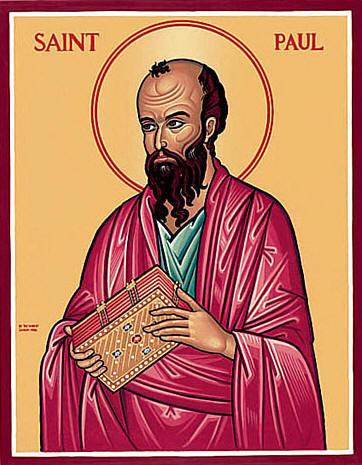
Wednesday, March 16, 2016

THE APOSTLE PAUL - Part III

St Paul in Ephesus
In this final post on the apostle Paul (for now), I wish to examine his legacy.  It would have been interesting if the New Testament canon had been laid out chronologically . Being that Paul's letters  are the first known writings of the New Testament would have placed them in front of the gospels.  I think doing so would offer readers a different perspective on the gospels and would have allowed the reader to understand how much Paul's perspective is reflected in what became written about Jesus in the four gospels that ended up in the New Testament. 

In examining Paul's legacy, it is important to keep in mind that his writings occur within the context of the Church of Jerusalem's existence, the spiritual center of the early church, just as the Temple was the center and focal point of Judaic worship.  Christianity was very much understood by the earliest Christians to be Judaic, a part of Judaism. The link between importance of the Temple and the church in Jerusalem is undeniable.  This ultimately played a major role in the promulgating Paul's theological perspective, when both the Temple and Church in Jerusalem were destroyed in 70 CE and Paul's theological views of the church became the foundation upon which the church grew throughout the Roman Empire.

Paul's endeavor to include gentiles into the emerging early Christian church without the need for conversion to Judaism and male circumcision led to development of what I referred to as his adoption matrix, whereby every Christian was considered an adopted child of God until such time all, like the resurrected Jesus, become the raised, spiritual children of God. This was a very inventive approach that, for the first known time in Judaic history, the centerpiece of Judaism  - adherence to the law - was questioned as relevant to the concept of righteousness in the sight of God.  Paul did not take this lightly and his writings illustrate a torn individual who struggles with his past relationship to the law and it's relevance in the light of God's unmerited grace.

Paul was a rational visionary, who greatly expanded the Christian church.   His reasoning abilities provides a template for further development and has been, in fact, the inspiration for most of what is considered Christian doctrine and dogma.

As I have said in another post, the Holy Bible helps us form our questions rather than give us the answers to them.  Times change and we need to have the ability to reinterpret these ancient scriptures, much the same way the apostle Paul took liberties in redefining the meaning and purpose of Judaic law and the prophets of the Hebrew Scriptures in the light of his visionary experience which led him to embrace the unmerited grace of God.
Paul's use of logic is refreshing but is under-appreciated. He has become so mainstream today, that few realize the radical inventive way he utilized Hebrew scriptures to support his theological perspective.  Reason in religion may not be everyone's cup of tea, but Paul underscores the necessity of reason in forging a path for the good news of the risen, spiritual Jesus who becomes the Christ of God. While Paul referenced little of what Jesus taught during Jesus' ministry as recorded in the canonical gospels, he undoubtedly has helped shaped many of the teachings about Jesus.

Because Paul employed a logical and reasoned approach in his writings he also understood the limits to which he could know, to which he could reason.  His visionary experience led him to a realm of the unknowable, what some would call mystery. Even here, Paul identifies tools to utilize on this side of life that help us deal with the mystery we find ourselves in, life.  Faith, hope, and love become the centerpiece of Pauline theology, what I have referred to in other posts as the affective elements of life; that help shape our responses to what our life experiences bring.

What I have not spent a great deal of time discussing in these posts is Paul's reference to the Holy Spirit in his writings. The Holy Spirit is ubiquitous throughout Paul's epistles.  It becomes that eternal presence in our temporal existence working in, through, and with our acts of faith, hope, and love.  The Spirit of God becomes the bloodline and life force of Paul's version of the Church, the spiritualized Body of the risen Christ in this world.

The spiritual realm that Paul writes about is breathtaking in scope. It gives wide berth to expand our thinking and perspectives especially with regard to Paul's concept of God's grace which, by Paul's account, is limitless.  Neither Paul's mind nor ours can wrap themselves around such limitlessness.  Room for growth, the expansion of God's Spirit, and the ever evolving meaning of the Church as the body of Christ is evident in what Paul writes.  What limits he mentions appear based on human kind's inability to look past our dimensional perspective and limited knowledge.

As with the ministry of Jesus, I do not see Paul's work complete.  Incompleteness is woven into the very fabric of Christianity.  There is always work to be done. The "once-and-for-all-ness" of Christ's death and resurrection is not an end but rather a beginning on this side of life.  Paul's emphasis that a new creation is afoot hints at a completeness yet to come, not mission accomplished.

The apocalyptic and eschatological strains that are embedded in Christianity and in Paul's writings do not, in my opinion, necessitate having to be interpreted as they were some two thousand ago.  Paul may have been caught up into that mindset and may have been expecting a return of Christ within his lifetime ...  but maybe not.  His visionary experience opened him to the likelihood of a greater reality that breaks into our present world and co-exists with the present until such time as this world no longer exists.

Paul was capable of skepticism and at times he expressed it in roundabout ways.  If he had not been skeptical he could not have been receptive to his vision; Doubt is a key to what appears to be a locked tight mind. To apply and paraphrase a saying of Leonard Cohen, it is the crack that sometimes let's the light shine through.

Paul could not have argued Judaic law from the perspective of certainty.  He could not have put forward the affective elements of faith, hope, and love in the manner he did.  These ideas and principles did not proceed from a certain mind, but rather  a questioning one.

What permits Paul to think freely is his ultimate trust in God's faithfulness, hopefulness, and love as discovered in his vision of the risen Christ Jesus.  In this sense, Paul, more than any other person of the early church period, shaped the Christian Church we know today; a church that continues amidst its failures and setbacks.

Until next time, stay faithful


Thursday, March 3, 2016

THE APOSTLE PAUL - Part II

The Church of Saint Paul the Apostle

Note: All quotations from the Holy Bible in this post are from "The Holy Bible, New International Version," Copyright 1984 by International Bible Society.  

In my last post on the apostle Paul, I focused primarily on his attempt to circumvent the Church in Jerusalem's requirement that male gentiles desiring to become Christian must first convert to Judaism.  As such, Paul views Jesus' resurrection as a reset point, God's new creation, upon which Paul  premises his adoption matrix that put both Jew and gentile followers of Jesus on equal footing as "adopted" children of God by faith rather than lineage.   In the process of making his case that faith alone in Christ Jesus as the only requirement for inclusion, Paul takes issue with Judaic law, as a whole, which was received poorly by the leaders of the Jerusalem church.  In the end, Paul manages to convince James, the brother of Jesus and head of the Jerusalem church, that circumcision was unnecessary, but James and the other leaders maintained that the law must be followed.

What we experience in reading Paul's epistles is Paul's mind at work.  Although his legal argument on Judaic law, to my mind, is a bit convoluted, Paul was making a logical argument regarding the futility in trying to meet every possible demand or requirement of Judaic law as necessary for righteousness in the light of God's unmerited grace.

In this post, I will examine Paul's understanding of Jesus' resurrection and the new creation it heralded.   To do so, we must understand the impact of Paul's vision Jesus on the road to Damascus. The important fact to keep in mind was that this encounter was a vision - not a physical presence. Visions were understood in Paul's day as a spiritual rather than a mental process that one could psychoanalyze.  The spiritual, throughout most of human history, was and continues to be considered every bit as real as a physical encounter in many parts of the world and at least until the dawn of psychoanalysis in other parts.  In fact, Paul had a physical reaction to the light of Christ perceived in this vision, he became blind.

The significance of this is that the spiritual was not separated from reality or a separate reality. The spiritual was real and was not questioned in Paul's day as it is today, where we tend to view spirituality as a mental process rather than a form of being or existence in its own right.  In fact, during the time of Paul it is likely that most understood spirit as a reflection of a greater reality that physical reality was dependent on and which could and did interact with the physically mundane world from time to time.

The physically animated world was largely referred to as flesh in Judaic thought, and Paul's writings and understanding of the physical world reflects that perception.  Flesh was observed to be corruptible. When a person or an animal died, flesh would decay; therefore, the physical is impermanent and the spirit permanent.  This is key to Paul's understanding of Jesus' resurrection. In fact Paul utilizes the concepts of corruptible and incorruptible in correlation to resurrection in his epistles. Although Paul's use of these terms implied a double entendre, the basic meaning is simply there are aspects of reality that last and aspects that don't.

In Judaism, what makes humans the very image of God is that God breathed his spirit in us.  By virtue of this act, we are spiritual creatures as well as physical ones.  Paul tends to side-step this fact of Judaic theology.  The adoption matrix that Paul utilizes  is, I believe, an outcropping of the Judaic concept of the Chosen People, the children of Abraham, which Paul asserts was reconfigured at Jesus's resurrection to potentially include all people by virtue of their faith in the resurrected Christ. Paul's sidestepping of what is referred to in Judaism as the Noahide covenant is not a denial of it.  Paul's intent was to broaden the Abrahamic covenant to include all who had faith in Jesus as the risen Christ.

PAUL AND RESURRECTION

I would invite readers of this post to review with me Paul's explanation of Jesus' resurrection as found in his first letter to the church at Corinth, 1Corinthians 15. What we find here is that Paul never affirms or posits a belief in the physical resurrection of Jesus. What I believe confuses people is that Paul talks about the body or talks about mortality putting on immortality, which to most means a physical body, but Paul is not talking about the resurrection in terms of a physical body, but rather as a spiritual body.

In verses 44 through 50 of  1Corinthians 15, Paul writes:

"If there is a natural (physical*) body, there is also a spiritual body.  So it is written:  "The first man Adam became a living being;' the last Adam (Jesus*) became a life-giving spirit.   The spiritual did not come first, but the natural, and after that the spiritual.  The first man was of the dust of the earth, the second man from heaven.  As was the earthly man, so are those who are of the earth; and as is the man from heaven, so also are those who are of heaven.  And just as we have borne the likeness of the earthly man, so shall we bear the likeness of the man from heaven. I declare to you, brothers, that flesh and blood cannot inherit the kingdom of God, nor does the perishable inherit the imperishable." [*=my insertions]

A platonic understanding of reality  seems apparent or perhaps is being referenced in Paul's logic regarding reality. The physical world is impermanent - not all that real -  a shadowy place - a mere reflection of what truly is or meant to be "for now we see but a poor reflection as in a mirror" (1Corinthians 13:12)  The spiritual world is the true reality.  The resurrection of Jesus, by being a spiritual event resulting in Jesus acquiring a spiritual non-physical body, is in a greater type of reality - a lasting reality.

Paul may have adopted some of this thinking from the Essenes, but as a Pharisee, this seems unlikely. What also seems as unlikely is that he would have acquired such a negative view of God's original creation, but somehow he did and I believe the answer resides in his Hellenized understanding of reality which was largely dualistic; there is that which now appears real but is merely a shadowy reflection and then there is that which is truly real which we cannot fully understand on this side of life.

As I mentioned in my last post, what I see Paul doing is an attempt to bridge the gaps between the two mindsets he possesses, which becomes essential to Paul's manner of coming to terms with the vision he received and his endeavor to include gentiles into the Church without the need to convert to Judaism.  The vision Paul experienced shatters his Pharisaical allegiance to the idea righteousness via compliance to Judaic law.  

The key to this shattering moment is on the voice of the "spiritualized" resurrected Jesus who says, "Saul,  Saul why do you persecute me?" Acts 9:4.

There is an answer to that question.

The reason Paul persecuted members of the early church is because as a Pharisee, he believed he was doing the right thing, complying with the letter of Judaic law, only to come to realization via his vision that he was doing something very wrong, blind to a greater reality.

In my opinion, Paul never fully recovers from that realization and is torn by what he knew prior to this vision and the realization that after this vision, he knows that he knows nothing which brings to the forefront of his thought process what can be referred to as his Greek mind.  Paul seemingly cannot resolve this disconnect with his Pharisaical past through his understanding of Judaism.  This becomes an enormous struggle for him that ironically finds a way to resolution when he sees gentiles embracing the gospel message he intends for his Jewish brethren.

The question that one speculates to have formed in the back of Paul's mind becomes why was it easier for gentiles to embrace his message rather than his own Jewish brethren.  The answer becomes obvious.  There is no legal or theological barrier preventing them to do so.  

What Paul runs up against is his own past, the intransigency of the Judaic mindset regarding the law. The leaders of these Jewish communities are not willing to give up what was holding them together, the law, and there was no easy way for Paul to argue that they should do so from the perspective of Judaic law. So Paul abandons any legal argument and introduces a philosophical, a Greek, argument instead which is based on his notion of God's reset point of creation in raising Jesus as a new spiritual creation.

While Paul cannot argue the gospel message from a legal perspective, he finds a reason to sidestep it and thus argues that all of the law's requirements have been met in Jesus' death and resurrection: "The death he died, he died to sin once for all; but the life he lives , he lives to God." (Romans 6:19)

In essence, Jesus's death is the "once and for all" atonement for the sins of the world and his resurrection is God's approval who reset the creative paradigm as a result.  The basic message is that in order to become part of this new creative order one; to be on the right side of God, only has to have faith in Jesus as the risen Christ.

NOW AND THEN

This logic raises other questions:  If God has reset the creative paradigm, what had changed? Why weren't Paul's audience seeing its effect now, experiencing it in real time?  

Paul never directly addresses this, and perhaps did not see a need to at the time, but he indirectly does by regular use of the terms "now" and "then."  Chapters 12 and 13 of First Corinthians is what I configure as the "Now and Then" discourse by Paul.

What Paul describes in these chapters could be likened, in modern parlance, to a parallel universe that exist side by side that have  breakthrough points called revelations or a multiverse that has an added eternal dimension, not defined by space or time.  

Of course, Paul was not thinking any of that in his day. Instead Paul simply stays within the context of "this world and the next."  In the "now-time" or meantime of the present, the greater reality of the new creation becomes spiritualized.  It exits and has always existed due to its eternal nature and has been at work ever since the dawn of time. 

What has changed is the awareness of the new creation by the presence of God's Holy Spirit.  The Pentecost event was the point where the new creation merges with the old creation until such time the old completely passes away. 

Eschatology is very much a fixture of Christianity.  There is this time, "Now," and there will be a different time, "Then." Given the eschatological mindset at the time, especially within Judaism, with its tendency towards the apocalyptic, the concept of this world and a world to come morphs into Christian theology.  It is what Paul does with it that is of interest here.   Paul uses these terms to great effect in these two chapters.

Paul himself, introduces a mild form of skepticism, into this eschatological view.  In fact I suspect Paul in both chapters 12 and 13 addresses his own questioning mind. The result is one of  Paul's most profound works placing the present, the Now, in terms that have endured and sustained the church in its mission as Christ's presence in the world to this day.  

At this point, I would advise my readers to read First Corinthians 12 and 13.  Paul's underlying answer to all the "big" questions about how this all comes together is in essence, "I don't know.  I don't have all the answers to all the questions." 

He doesn't say that, of course, but it is there, implicit in what he provides; in his use of Now and Then.  This what I find most appealing about Paul, his honesty. 

Paul writes about what he sees and feel, but he doesn't stop there.  Paul wisely knows there is a limitation to what one sees and feels and suspects there is more than what one can see or feel within the limitation of our physical senses.

Paul sees the church made of people with various abilities and strengths.  He calls these gifts.  He also sees the church as acting, through the animating power of the Holy Spirit, as Christ's presence, Christ's risen body in the Now-world. 

Paul's concern is with what he now knows, those who have come into the church.  This becomes his focus in the Now. He doesn't pretend to have all the answers to all the questions.  It is in this unknowingness of Paul that he offers something much deeper than sight and sense.  He offers what I have referred to in past posts as the affective elements of faith, hope, and love.  In essence, Paul says that on this side of life we cannot possibly understand everything there is to understand, but that a lack of understanding should not become an obstacle to doing, or to being.  I think this is becomes one the most enduring messages of Paul to any age, but is particularly relevant to our current times. 

In observing the church's growth, he saw the effects of faith, hope and love first hand; how life-giving they are and how sustaining they are to human life.   At the end of chapter 13 of First Corinthians, Paul writes,

 "For we know in part and we prophesy in part, but then perfection comes, the imperfect disappears.  When I was a child, I talked like a child, I thought like a child, I reasoned like a child.  when I became a man, I put childish ways behind me.  Now* we see but a poor reflection as in a mirror; then* we shall see face to face.  Now* I know in part; then* I shall know fully, even as I am fully known.  And now* these three remain: faith, hope and love.  but the greatest of these is love.

[*emphasis mine]

Until next time, stay faithful.


Monday, February 29, 2016

THE APOSTLE PAUL - Part I


Commentary of St. Paul’s Hymn to Love (1 Corinthians 13) | Mind ...

Note:  In this post I am beginning a short series that examines the evolution of salvation theology at the very beginning of Christianity.  What I find intriguing is that the earliest known documentation of this event is not the gospels but rather the epistles of the Apostle Paul, a rather enigmatic figure, who shows up on the Christian scene after this event, "as one untimely born" 1Cor. 15:8.  The question that arises is whether Paul is writing from what he was taught after his conversion which later are compiled in the four gospels of the New Testament or does Paul's theology shape and influence how the gospels are eventual written.

I like Paul.

I need to say that up front because as you read this post, you may be led to think otherwise. For instance, I don't agree with everything Paul says, or, to be more specific, I don't agree that everything that has been attributed to Paul is Paul speaking; as in, his being named the author of the letter to the Hebrews, the two Timothy letters, and Ephesians.  

Paul is, in my opinion, the first authentic Christian.  In fact, many people consider Paul to be the founder of Christianity. I won't argue that.   There can be no doubt that Paul's letters shaped and continues to shape Christianity.  What I like most about Paul is that the letters he wrote reveal an authentic human who writes from both the head and the heart.

Paul's letters strike me as a rarity in ancient literature because of the personal content that is poured into them.  What I find in Paul's letters is a mind grappling with a newfound faith-source.  Paul is constantly torn between his conflicting identities; that of his former identify as Saul and his converted identity as Paul.  In Paul I find a combination of characteristics the likes of Jacob and Jeremiah  found in Hebrew Scriptures, a person who struggles with who he is and then is compelled to talk about it.  As such, Paul becomes an interesting character study whose writings invite a certain degree of analysis.

What intrigues me most about Paul is that his letter predate all other canonical literature in the New Testament.  The layout of the New Testament canon is misleading; in that, it is not concerned about the chronological order of the writings it contains. Instead its format begins with the "historical" account of Jesus ministry and life, then proceeds to Acts of the Apostles and finally to the letters of Paul and others.  It gives the impression of being in chronological order when in fact it is not.  What is also confusing is that Paul's letters are not in any chronological order themselves and begins with what might be considered his last epistle, the Epistle to the Romans, which presents what many might consider his most mature theological writing.

My reason for writing this post is to examine Paul's understanding of the resurrection event which is so central to his theological perspective.  This may sound like a waste of time to devout Christians who readily believe in and accept the physical resurrection of Jesus on Easter and who assume that their understanding of the resurrection is the same as Paul's understanding.  I contend, however, that Paul's view of the resurrection is not what most Christians think it is or understand why it becomes so central in Paul's theology to the point of excluding almost everything that Jesus said or did prior to his death and resurrection. 

As a historical figure, it is difficult to know Paul.  One can deduce from his writings something of his mind and theological perspective.  We also have the Acts of the Apostles that give us some idea of Paul within the historic context of his time.  The tendency by modern Christians is  to ignore the contentious environment Paul's ministry caused and the role it played in forming his theology.  In this post  I will briefly delve into what I feel leads Paul to interpret Jesus' resurrection in a way that is unfamiliar to most, even though, it is quite evident in his letters.

Finally, as an introduction to Paul, I am positing that all four of the gospels are likely to have been influenced by Paul's theological view of the resurrection event rather than they influencing his theology. Whether Paul's particular view of Jesus' resurrection was entirely Paul's idea cannot be fully established.  What can be established is that he is the one who writes about it.

Pauline theology becomes the foundation upon which orthodox Christianity is built.  I contend that Paul's theology was catapulted into eventual dominance as the result of a singular historical event that changed the religious landscape of Paul's time. I will explain further along in this post.  For the moment I need to say a few words about Paul as a person.

PAUL AND PARADOX

Paul is a paradox of tragedy and ecstasy all rolled into one package.  He's both slave of Christ and freed by grace.  Given this dichotomous mix, Paul does what most of us do, try to find a balanced emotional response to our inner conflicts.  He suffers in his joy and rejoices in his suffering.

Paradox abounds in Paul's very fabric.  Paul as Saul persecuted the early Christians. Paul is the Johnny-come-lately apostle.  He never knew Jesus prior to Jesus's death and resurrection. Throughout his ministry Paul readily identified and prided himself as a being a Pharisee in several of his letters. He comes to know Jesus through revelation via a vision.  As a result of his conversion and persecutory past, Paul is reluctantly received into the Church at Jerusalem and sent as a missionary to spread the gospel to Jews throughout the Roman empire to help support the Church in Jerusalem.

Paul is also a product of two world views.  He is both a Jew and a Roman citizen. Not much is made of this until his arrest in Jerusalem where he reveals that he is a "natural born" citizen of Rome.  There has been much speculation about this with some putting forth that Paul's father was awarded citizenship or bought it at some point.  A more likely scenario, in my mind, is that Paul's father was a natural born Roman citizen and his mother was Jewish, since being Jewish is conveyed through the mother, not the father. It is clear that Paul was raised Jewish which could mean his father was a gentile follower of Judaism. 

As an apostle sent to spread the gospel to the Jewish communities located in larger cities of the empire, Paul finds that his most willing converts are not Jews, but rather gentiles who are attracted to Judaism or who are intrigued by Paul's message.  His familiarity with the Hellenized world likely provided a urbane patina to his delivery of the gospel.  For example, Paul's familiarity with Greek mythology and philosophy is evident in his speech to the Athenians in the Agora ( Acts 17: 16-34).

THE ACTS OF THE APOSTLES - THE GOSPEL OF PAUL

Paul's journey into Christianity is strictly about his relationship to the resurrected Christ he encountered on the road to Damascus. Paul's vision-like encounter with Jesus on the road to Damascus is crucial to understanding Paul. The only thing Paul sees in this encounter is a bright light, but the voice he hears is identified as being Jesus.  The experience left Paul physically blind, and spiritually confused. It was for Paul  a religion-shattering moment.

The Acts of the Apostles traces the history of the early church from the point of Jesus' ascension into heaven through Paul's supposed final journey to Rome.  The first six chapters of Acts do not mention Paul, but rather spends time talking about Peter and setting the stage for Paul's arrival at the end of Chapter 7, the account of Stephen's martyrdom, which has Paul holding the cloaks of those who stoned Stephen to death.

Acts attempts to fill in the blanks to what Paul alludes to in his Epistles.  Undoubtedly the Acts of the Apostles was written after the time of both Peter and Paul and would place it somewhere in the vicinity of last two decades of the first century CE, if not slightly later.  From chapter seven to the end of Acts, chapter twenty-eight, Acts follows the travails, travels and trials of Paul  The Acts of the Apostles clearly places Paul, not Peter or even Jesus, as the major architect of the Christian Church. 

PAUL AND CHRIST

Paul's relationship to the historical Jesus; the Jesus who lived in Galilee, told parables, healed the sick, preached in the synagogues and on the mountain tops is non-existent.  He knows Jesus only after the fact of his life on Earth.  As such, Paul makes mention of only one direct quote that was attributed to Jesus before his crucifixion and that is in relation to the Last Supper, what is commonly referred to as the words of institution (1Cor. 11:24-25).  The only other quote Paul makes is asking Christ to remove his thorn in the flesh to which Christ tells him in some manner, "My grace is sufficient..." (2Cor. 12:9). That's all Paul ever presents as a direct teaching he received from Jesus mentioned in his epistles. 

Everything Paul talks about in his epistles refers strictly to Jesus as the Christ.  Paul never mentions Jesus's birth stories, his relationship with his disciples, Jesus' mother, any of Jesus' parables, his Sermon on the Mount, his miracles.  There is no way of knowing what Paul actually knew about the earthly ministry of Jesus.   As far as Paul is concerned (based on his epistles) the only activities of Jesus' human life on this planet, relevant to Paul's ministry, started on Maundy Thursday and ended on Good Friday.  Easter begins a whole new chapter when Jesus becomes, in Paul's lexicon, the risen Christ.

PAUL'S ADOPTION MATRIX

One of the curious terms used by Paul, particularly in his epistle to the Romans, is the word adoption. It is used three times in this epistle:  Roman 8:15, 8:23, and 9:4.  He also uses it in Galatians 4:5. Why adoption and not a straight out claim that everyone, by virtue of one's birth, is a child of God as intimated in Genesis 1 is, in my opinion, one of the perplexing questions that Paul's epistles raise.

Paul's use of adoption appears to be a theological attempt at bridging a religious gap that was the result of Judaism's indelible link to the Jewish people and the fact that Christianity, in its nascent years, was very much linked to Judaism as an emerging Judaic sect, not the separate religion it is today.

Paul's world was largely polytheistic, and in an empire that was cosmopolitan; where people could largely practice whatever religion they chose as long as they gave their due to the imperial religious cult, ethnic religions were viewed with suspicion by the Romans.  Rome tolerated Judaism in order to keep the peace.  Palestine, as a province within the empire, was allowed to practice its religion, Judaism, without interference and by extension Rome offered limited protection to Jewish communities that existed throughout the empire.  Rome did not particularly like Judaism which viewed its accommodation of it as a practical annoyance, and in less than a decade of Paul's death, Rome would actively attempt to eliminate it.

This was the tense environment in which Paul is writing.  This environment undoubtedly shaped Paul's theological perspective. Paul's initial mission was to bring the gospel of Jesus to ethnic Jews who were not familiar with this new brand of Judaism.  The object was to garner adherents and financial support for the church in Jerusalem.  Given the cosmopolitan atmosphere of the empire, many Jewish synagogues had a gentile following, some were proselytes, some remained gentile followers.  As a result, Paul's message appears to have resonated with this gentile audience more than with the ethnic Jewish community.

Given the tenuous situation these Jewish communities were in undoubtedly led the leaders of the synagogues to avoid as much conflict and attention of the Roman authorities as they possibly could. They tried to avoid at all costs anything that would draw negative attention to them or that would undermine the continuity of  these communities.   Paul's new version of Judaism was not well received by these leaders.  After being thrown out of the synagogue in more than one city and on more than one occasion, Paul carried his message to the streets which caught the attention of other gentiles and the gentile church began to grow. This created tension between the leaders of the church in Jerusalem and Paul.

[Side Note:  The tension in the Book of Acts is attributed to the Pharisees who were members of the Church in Jerusalem.  It should be noted that during Jesus' time the Pharisees were intrigued by, if  not, friendly towards Jesus. That they get a bad reputation in the gospels may have more to do with the contentious relationship they had with Paul within the Church  at Jerusalem which was later written back into gospel narratives.  It was Sadducees who sought to kill Jesus, not the Pharisees. In fact, Luke 13:31 says the Pharisees warned Jesus that Herod was out to kill him.]

What Paul experienced in his ministry was surprise at the capacity for faith of those outside the Jewish community.  As such, faith becomes the cornerstone for Paul's paradigmatic shift in theology, but this is not easy path for Paul to take.  As a Pharisee, Paul is well aware of the legal obstacles that stood in the way of a straightforward path to inclusion of gentiles into this new Judaic sect called, "The Way."  While he works for the inclusion of gentiles into the church, he struggles within himself on how to address the turmoil it creates. 

It seems reasonable that what comes to bear on Paul's thought process is not his Judaic upbringing but rather his Hellenized one. Paul is simply trying to present his case in the form of Socratic argument: "If this then that..."  and so on.   In order to do so, however, Paul had to base his premise on something that would enable him to make logical argument that would support the inclusion of gentiles into the church without having to become Jewish.

THE RESURRECTION RESET

To accomplish this Paul establishes a new paradigm based on the concept that Christ's resurrection is a new creation, a reset of God's original creation.  Jesus becomes the Christ of God, the new Adam of God's new creative order.  Jesus, as the Christ of God becomes the heavenly (spiritual) first born Son of God by virtue of being raised by God from the dead as the first fruit of a new spiritual creation. [1Cor. 15:45, 2 Cor. 5:15, and Gal. 6:15]


Of course this leads to a host of questions. What does this mean for the Chosen People, the Jews?  What does this mean for the rest of humanity?  Paul begins walking a fine theological line.  In making Jesus the first-born, the spiritually-natural born Son of God by virtue, not of his physical birth by Mary, but by his divine birth of being resurrected to new life by God the Father, Paul levels the playing field.  There is no Jew or Greek, no male or female, no slave or free man [Gal 3:28]. Ethnicity and any other identifying mark that differentiates us on earth (on this side of life) is removed, means nothing.

As a Jew, Paul saw himself as child of Abraham and as a Christian Paul saw himself more than that; he saw himself as a child of God through "adoption."  Paul reads this formula back into who he identifies as a true child of Abraham - one who has faith in Christ Jesus as one's Lord and savior. The argument becomes rather convoluted in his Epistle to the Romans. Paul speaks specifically about the patriarch of the Judaism, Abraham's, faith and connecting Abraham's faith to faith in Christ as synonymous types. In fact, Paul reads Christ into almost every important event in the history of the Hebrew people. 

At the reset point of Jesus' resurrection, Paul says the best we can get to on this side of life is adoption.  We can be adopted as children of God, made heirs with Christ by faith in the resurrected Christ Jesus.  We have to wait, however, for our own spiritual rebirth at the time of final resurrection. This becomes Paul's answer to the issue of whether a male individual needs to become a Jew; that is, circumcised before being identified as a Christian because such identities mean nothing in the light of Jesus' resurrection and God's new creative order.

Paul's point is that the only thing necessary for salvation is to have a faith like Abraham's, a faith embedded in Christ Jesus.  In trying to bridge the ethnic gap of who is considered a Christian and who is not, as with all attempts to differentiate who is and who isn't saved, Paul, in my opinion, fails to make the definitive leap of faith of full inclusion of the human species as beneficiaries of God's grace. 

Paul's use of adoption implies that everyone is at the reset point on this side of life and, as yet, is not a natural/spiritual born child of God. This theological point will continue to shape Christianity's theological perspective throughout the millennia to the present. It will figure prominently in Augustine's doctrine of original sin.  The logical result of Paul's adoptive matrix says if you're not a child of God than you must be a child of someone else - a godless child of the world, a child of the flesh.  The term "flesh" is oft repeated in Paul's letter to the Romans as a pejorative. Adoption on this side of life becomes the assurance of becoming a full heir with Christ at the final resurrection.

Another logical consequence is that the adopted do not choose the adoptive parent, the parent chooses the child. Paul falls extremely short of saying that everyone is adopted.  In fact, he falls short of saying that adoption is open for everyone.  Instead, Paul works from the perspective that not everyone is going to be saved; that some will be lost, including, those who claim to be children of Abraham.  As such Paul introduces the Church to the concept of predestination [Roman 8:29 & 30 which is further developed in a work some attribute to Paul, Ephesians 1:5 & 1:11]. It is important to remember that although Paul worked for inclusion, he lived in a world of dualism and his thought process was dualistic.

Paul also takes issue with Judaic law and spends a great deal of time discussing this.  While he cannot find it within himself to outright deny its relevance he tries to mitigate its redemptive effectiveness. Paul argues that the law is effective on this side of life, but it cannot lead one to become a child of God; that only faith in Christ Jesus can accomplish that as an act of God's grace through no personal merit on any person's part - It's not something we choose. 


A CATAPULTING EVENT

Near the end of Acts, we read that a compromise is reached with the leaders of church in Jerusalem and James, the younger brother of Jesus.  The Church in Jerusalem will accept uncircumcised male gentiles into the fold on the condition that they keep from things offered to idols, and from ingesting blood and meat that was strangled, along from refraining from fornication (Acts 21:25).

As part of the compromise it is evident that Paul must take a penitential, atoning stance, having to shave his head, and purify himself and commit to being "orderly and keeping the law."  (Acts 21:24).  Ironically, as Paul is making a show of penitence for his endeavors in Jerusalem he is arrested, tried before the Sanhedrin, claims his Roman citizenship and is packed off to Rome to be tried by Caesar.  We never know for sure how things turn out for Paul. 

What catapults Paul's letters to the authoritative level they now have is not that his views were accepted by the church in Jerusalem, because they clearly were not, but rather the Fall of Jerusalem in 70 CE, which not only saw the destruction of the Temple but also the church in Jerusalem.  This event would also foster the split between Judaism and Christianity.  Paul's reasoning did not win the debate with Pharisees within the church at Jerusalem and it is the Pharisees who survived the events of 70 CE and kept Judaism alive.  Since there was a clear division between Christianity and Judaism, the Pharisees end up being unjustly vilified, for the most part, in the Christian gospels.

Had the events of 70 CE not occurred, one can only wonder if Paul's epistles would have remained as influential as they became.  Paul's theological perspective was shaped both by his experience of the risen Christ and his experience with the conversion of gentiles to Christianity. Paul defines Jesus' resurrection as a reset point in story of human salvation - "If Christ be not risen, then is your preaching vain, and your faith is also vain." [I Cor. 15:14] 

What evolves from Paul's personal struggle over inclusion and his adoptive theology will be the subject of future posts.

Until then, stay faithful.


Monday, February 15, 2016

A HOLY LENT

Then the devil took him to Jerusalem, and placed him on the pinnacle of the temple, saying to him, "If you are the Son of God, throw yourself down from here, for it is written, 'He will command his angels concerning you.'"  Luke 4:9&10a 

(All texts in this post are in accordance with the Revised Common Lectionary and taken from New Revised Standard Version Bible, copyright 1989 by the Division of Christian Education of the National Council of the Church of Christ in the USA)

On this first Sunday in Lent, we begin where we left off on the First Sunday after Epiphany; after Jesus' baptism by John, with Jesus driven by the Spirit into the wilderness for forty days; the forty days we commemorate during this season of Lent. We find ourselves with a weary and worn out Jesus, who has been fasting and praying.

As we walk with Jesus through the wilderness on this side of life, we hear, along with Jesus, the tempting voice  (personified as the devil) telling Jesus - telling us - showing Jesus - showing us what could be if we just give up and give into the momentary illusion of perpetual self-gratification, popularity, and power. 

There's a great deal of human logic in this voice.  Its worldly wisdom resonates with our pragmatic, albeit short-sighted perspectives, of looking out for "number one - prompting us to ignore the messes of the present and choose those elusive, greener-looking pastures that are always just beyond our reach.
  
+ + + + + + + + + +

We see Jesus resisting with every ounce of his being:

To the temptation of perpetual self-gratification, the temptation to turn stone into bread - to fulfill one's desires whenever and with whatever is available, Jesus says, "It is written, 'Man does not live on bread alone.'"  (Deuteronomy 8:3)

To the allure of become the darling of the world, if he would give in and bow a little - just says please - Jesus says, "It is written, 'worship the Lord your God and serve him only.'" (Deuteronomy 6:13)

The greatest challenge is save for last; tempting Jesus to test himself in order to get and answer to that perennial existential question, "Who am I?"

"Who am I?" - "Who are we?" form a subconscious loop prompting us to define who we are as individuals and groups at any given moment or situation.  In the moment of Jesus' fasting and prayer, the challenge was, "Who are you Jesus?"

"Are you really God's son?"

Doubt can be a burden too great to bear.  The human mind wants to know - And all Jesus had to do to get the devil off his back and out of his head was to prove the he was God's son. 

To make this more challenging, the devil takes Jesus (takes us to the pinnacle of the Temple) God's house on earth:

"Surely, if you are who you say you are; God's son (God's children), surely God won't let something bad happen to you in God's own house - in his own back yard!"

"Are you who you think you are?  Why don't you jump and find out?"

"Do you really have faith in God, because if you don't jump, are you too afraid to find out?"

"Jump - Prove your faith."

"Is God really watching out for you?" 

"Come on - take a good look at yourself, Jesus.  You've been through the wringer these past forty days.  You're a mess."

"Where's your abba - your daddy in all of this?  Is he even here?" 

"You want to know, don't you?   I know you do"

"Jump."

"It'll be a win/win outcome for you. If God saves you, fine, - I go away.  If not... well - at least you won't be living...  a lie."

"Surely, God will send his angels to protect you."  (Psalm 91:11&12)


   + + + + + + + + + + 

We are all subjected to such inner dialogues.  We are constantly tempted to go for the greener-looking pastures on this side of life, to bow to the temporal; to be a god for a season - 

And why not?  What do we have to lose?

Win/win - right?

Let's face it, it's hard to resist the vistas of temporal reality, hard to ignore the voices both out there and in here (inside one's head), challenging - questioning us to prove who we are and what we're made of. 

At the end of Luke's wilderness narrative, Jesus puts aside the need to prove himself and choose, instead, to listen to that voice which was still ringing in his ears of his heart, after his baptism; the voice of God saying, "You are my beloved, my son, in you I am well pleased."  (Luke 3:22) 

The same voice that spoke to our hearts in our baptisms - "You are mine and I am well pleased with you."  This too forms a continuous loop at the level of our hearts - that whispers ever so gently along with every one of our heat beats, in every moment and situation on this side of life.

The narrative we heard today in Luke is nothing more than a continuation of the narrative that started back in Genesis when this world-wise, serpentine voice got into Eve's head, telling her she had nothing to worry  about (a win/win situation) about eating the forbidden fruit - that she'd become like God. (Genesis 3)  It's a narrative that continues with us today.

Jesus, listening to the voice of God ringing in the ears of his heart, sent the Devil packing for the moment with these words, "It is written, 'Do not put the Lord your God to the test.'"  (Deuteronomy 6:15) 

 In Jesus's final response the devil's true agenda is exposed; trying to get God to jump. 

What tests us tests God.  We are, after all, made in God's image.  We are God's children.

 + + + + + + + + + + 

Throughout Luke's narrative, Jesus's responses were taken from the Book of Deuteronomy - Each one contains a sermon in itself.  We would do well to fill our mind with such scriptures as to take up enough space to limit the type of mental challenges that try to creep in.

The apostle Paul quoted Deuteronomy in his letter to the Romans this morning. (Roman 10:8b-13)  He reminded us, "the word is near you, on you lips and in your heart." (Deuteronomy 30:14)

St. Benedict, in his monastic rule, says, "Listen... and turn... with the ear of your hearts."  (Prologue to the Rule of Benedict)

We are free to choose to live in our heads - or - we can live from the heart, the dwelling place of God, the place where God speaks to us.

+ + + + + + + + + +


Lent is an old English word meaning Spring - a season of transition and change.  Turning - changing is a constant process on this side of life. 

We humans are, after all, seasonal creatures and creatures for a season.

We have come to associate the Season of Lent with reflection and repentance; as in, taking into account what we've done and  what we left undone and trying to amend or adjust our lives and way of thinking. 

The Franciscan contemplative and theologian, Richard Rohr tells us that the true meaning of  repent is to "change our perspective" to look at things differently.

("Alternative Orthodoxy - Week I - A Different World View,"  Richard Rohr's Daily Meditation, Center for Action and Contemplation, February 7, 2016)

Change is inevitable.  The only choice we really have with the challenges that changes bring is how to view them.

A Holy Lent literally means, "Other Spring." 

A Holy Lent invites us to look at this side of life "otherly; " from the heart rather than the head and to listen to voice that gently bears us up - the voice that says, "You are mine."


Until next time, stay faithful.


Monday, February 8, 2016

LOVE BEYOND BELIEF

So faith, hope, love abide, these three; but the greatest of these is love.
1Corinthians 13:13

 
Last but not least of what I have identified as the affective elements is love.  There is nothing certain in faith, hope and love except the potential capacity to deal with adversity, suffering, and the uncertainty of life. Being affective, they are influential in shaping our perspectives and responses to what life brings.

If you have never read 1 Corinthians 13 or haven't done so in long time, read it now.  The apostle Paul's treatise on love is, in my opinion, his finest moment.  The love of God commonly referred to as agape or unconditional love is present in all aspects of true human love, whether it be the love of family, friends, or the intimate, erotic love between two individuals.

There is no manifestation of true love that is not, at its core, agape.

UNCONDITIONAL LOVE

I reference this agape love as unconditional love as opposed to the conditional or conditioned love of infatuation, obsession, and possession.  Love that is unconditional resides in all of us, just as faith and hope resides in all because God resides in all, but like faith and hope unconditional love can be hidden and ignored by infatuation, obsession, and possession which fuel the illusion of certainty, the "forbidden fruit" of feigned truth.  Even the presence of God in our lives can be clouded over by these things.  Nevertheless, they are always present.

The reason Paul declares love to be the greatest of the three affective elements is because unconditional love is always present in every sincere act of faith and hope.  Paul and other New Testament writers offer marriage as the prime example for demonstrating and examining unconditional love, a place where unconditional love in action should be obvious, but, then as now, is unfortunately not always the case and is why the Christian epistles spend a good amount of time talking about presenting marriage as the union between Christ and his Church.  It's application, however, extends far beyond marriage, the family, and the Church.

Paul's definition of unconditional love is summed up in verses four through seven of 1 Corinthians 13:

Love  -

1.  Is patient
2.  Is kind
3.  Does not envy
4.  Does not boast
5.  Is not proud
6.  Is not rude
7.  Is not self-seeking
8.  Is not easily angered
9.  Keeps no record of wrongs
10. Does not delight in evil
11. Rejoices with truth
12. Always protects
13. Always trusts (πιστευει - always acts from faith)
14. Always hopes
15. Always perseveres

The Holy Bible, New International Version 1984 by the International Bible Society

What Paul lists as definitions or manifestations of love is the very image of God in action.  It is a very interesting list that requires more than a cursory glance.  It goes far beyond niceties.  It is presented as the lifestyle we humans were made for.

When I look at the list Paul provided, I am humbled because it appears to be such a tall order, and I know that more often than I care to admit I do exactly the opposite of the things listed.  What mitigates my self-loathing, however. is the fact that I'm not alone. Paul struggled with this as we all do. See Romans 7:18-20.  My point, however, is not to make an excuse but rather an observation.

When I look at the fifteen ways that unconditional love shows itself, it is not that I or anyone consistently demonstrate all fifteen manifestations all the time, but rather when any one of us exercises patience, kindness... refrains from being rude, looks past the wrongs of another...  rejoices with truth, etc. unconditional love breaks through.

What is important, therefore, is that we are mindful of the ways that unconditional love breaks through.

Not every situation is alike.  Some situations call for patience, some call for kindness, some call for restraint on our part, and some may even call for anger.  We don't always think of those moments as displaying love but Paul says they are, and I would agree that when we do these things from the position of care and compassion for another, unconditional love is active.

Near the end of this list Paul says there are some attributes of unconditional love that are always present.  Love always protects.  Love always trusts - always acts from the perspective of faith. Love always hopes. Love always perseveres.   What Paul tells us is that whenever we exercise unconditional love, these are always present.  "Always" in this sense literally means  "all ways."

Unconditional love is multi-dimensional. There is no known barrier that can prevent unconditional love from breaking through.  Whenever it is exercised in any of its forms it always protects whatever or whoever one is being patient, kind, or slow to anger with.  Unconditional love does not work from a perspective of knowing a certain outcome.  It is always acting from the perspective of faith and hope.  As such, it never stops being active.

The last of these always - "always perseveres" connotes the eternal love of God that is present in any acts of unconditional love.

UNCONDITIONAL LOVE IS NEITHER SELFISH NOR SELFLESS

Love seeks to fulfill the needs of the other as the only means of being truly fulfilled in one's self.

Love is never selfish or selfless.

In fact, Jesus tell us to love our neighbors and our enemies as ourselves. The reality Jesus is pointing to is that one cannot effectively love another person without having a sense of self love and self preservation; of seeing one's self as the other. We often hear of altruistic love as being a selfless act as in someone who preserves and protects the life of another human at the risk of losing one's own life.  Giving up one's life for one's friends or another person is not a selfless act; rather, it is the ultimate self-fulfilling act.

I am always impressed by the humility of those who have accomplished some heroic deed, who say, "I'm not hero.  I just did what I had to do" or something to that effect.  Such statements are a testimony to the self-filling aspect of love.  Love of the other has a rebound effect - saving the life of another is, in essence, saving my life. It is perhaps the greatest testimony to our sense of interconnectedness with all things.  Loving the other is loving myself - is loving God who resides in me and in the other.

Selfishness, like anything we deem "ish" in modern parlance; such as, meeting someplace at five-ish or as in the TV sitcom "Blackish," is saying that whatever is "ish" is not fully what that something is. To be selfish is not being fully self - fully who one is - is not a full self. 

Unconditional love can only occur in the context of the full self.

Unconditional love is transcendent and its effects are often unseen or go unrecognized in the short term. As such, unconditional love has an infective property that stays with a person to whom love have been given.

When working as a Human Rights advocate in a mental health institution, I would of my own volition seek out or at the request of a unit's staff or a psychiatrist meet with some extremely angry individuals, who on our first meeting would rake me over the coals in no uncertain terms and often in language that could wither a person, but I never reacted to the expressions of their anger which I saw and understood as expressions of pain.  I just listened patiently until I was told to leave, which sometimes could happen within a few seconds of meeting.

My first encounter with that type of anger, that type of pain, made me think I would not hear from these individuals again only to receive a call, sometimes weeks and even months later from that individual asking me to visit them.  All such experiences led to innumerable visits in which I listened to their pain and anguish, sometime for hours. It could be very draining, but eventually in all of these cases the person in the patient emerged. Where there was once only anger and anguish a smile would break through and laughter, and I knew that healing was happening.   This is why I believe Paul placed patience first in the list of unconditional love's manifestations.

If one is expecting an immediate return of love, especially when dealing with a difficult situation, than one is not loving in an unconditional sense.

STRONG LOVE VERSUS TOUGH LOVE

The term, "Tough Love" seems to be used less nowadays.  At least I'm not hearing it as much now that I'm retired, but when I worked in mental health I heard it used quite frequently.  I was never comfortable with that term.  Too often what is termed "tough love" is, in essence, obsessive or possessive love - conditional love.

This term frequently came to bear on situations where some adolescent was constantly misbehaving, getting in trouble with the law, and deemed unmanageable at home. Some parents were often at wits end trying to figure out how to control the unruly adolescent and would opt for a tough love approch; sending their adolescent to some type of stringent behavioral modification program, such as a boot camp.

While some adolescents left those experiences better behaved others didn't, and I often wonder about the long range effect of those experiences. What, if anything, did these adolescents learn about unconditional love?  How would they be as a father or a mother raising their own children?

I do not doubt that in some of these cases the tough love approach proceeded from the deeper unconditional love of the parents, but it's application in terms of it being tough love risked unconditional love being morphed to mean conditional love. In more than a few cases it's application was very much about conditions; as in, "You either do it my/our way or you can hit the highway."  Such approaches fell under the category of natural consequences, as in, "You brought this on yourself - You're on your own. I/we can't help you anymore." 

How many adolescents have been shown the door to their home by such conditional love?  I believe the numbers are growing and what becomes more distressing is that many adolescents are being kicked out of their homes or leave because they are not being loved, even when many come from families who identify as Christian or religious.

What a lonely place for anyone to be or not be, especially an adolescent.  It is nothing more than sentencing someone to a human version of hell. I have met people in that place.  I have seen the emptiness, the shell-like features of people in this hell, of what once was and what could be again if released from it. 

Christ descended to hell to release peoples' souls so that they could be.  Can we  who bear Christ's name do less?

LOVE BEYOND BELIEF

Perhaps Jesus's most notable teachings on unconditional love come in the form of two parables, "The Good Samaritan" (Luke 10: 25-37) and "The Prodigal Son" (Luke 15:11-32).

If unfamiliar, with either, read them now.

The parables of Jesus are multi-layered and, in general, address more than one situation.

In the parable of the Good Samaritan, Jesus differentiates conditional love from unconditional love and demonstrates that what constitutes true self love as being fulfilled in the love shown to an other.

The parable of the Good Samaritan is told in the context of a question given to Jesus by a student of Judaic law, a scribe.  He asks,  "Teacher, what must I do to inherit eternal life?"  The motive for asking this question has been subjected to speculation, but I believe it to be a sincere question given the fact that at the end of this story we are told the scribe gets the message.

Jesus took it as a sincere question and this story is Jesus's response to what lies behind the scribe's question which is a sincere concern for doing what is right - a sincere concern about his own well-being - a sincere expression of his self love.  It is the scribes sincere self-love that Jesus bases this story on.

So Jesus answers his self love question by showing him that his self interest, his self love, is only fulfilled in in serving the interests of others, in the act of providing unconditional love to another person.   An added but extremely important twist to the story is that Jesus demonstrates the universality of unconditional love by casting the person who acts from unconditional love as a Samaritan, someone who would have been viewed with contempt by Jesus's audience at the time.  In this story we see the extent to which unconditional love is applied.

Of course this story has many other applications and meanings, but the point I would make is that Jesus, in telling this story pushes his audience's concept of love - our concept of love - beyond the beliefs we have about who to love and the extent to which love should go.

In the parable of the Prodigal Son, the majority of the storyline addresses the doings or undoings of the younger son, but the storyline is told only to provide context to what Jesus is getting at, which is the unconditional love demonstrated by the father in this narrative.

One could easily question the indulgent nature of the father by dividing the inheritance he would leave his two sons and allow the younger son to throw his portion away on riotous living.  What comes to play in our adult, parental minds is our inclination to treat love conditionally.  I believe Jesus was well aware of that inclination in telling this story.

Jesus is moving us beyond that mindset to a deeper understanding about unconditional love.  Unconditional love is also about detachment.  There is a point in unconditional love, as the saying goes, "to let go and let God." Letting go is not about tough love but rather is about the strength of love that remains in place and at play even when we let go of the things and of people.  In the context of this story we see that unconditional love is about detaching from our infatuation with things, our obsession with having it our own way.  It is about letting go of our possessiveness of the people in our lives.

Through the younger son's narrative we learn something about the infective property of unconditional love.  When he hits slop-bottom (feeding on the waste thrown to the pigs), the love of his father that has always resided in the depth of his being emerges; a love that has always held him even when left to his own desires.

His father's love was the anchor of his soul that gave him the hope and the faith to finally pick himself up from slop-bottom and make the journey home.  He did so not knowing what reception he would receive, but in faith beyond any belief he anticipates - he hopes beyond any belief that some semblance of his father's love awaits.

When he is still at a distance, his ever faithful, ever hopeful, ever loving father runs to him and when finally embraced in the unconditional loving arms of his father - a love that surpassed all the younger son's beliefs, all is restored and love is returned.

Unconditional love, beyond any belief, always and in all ways comes full circle.

Until next time, stay faithful.


Monday, February 1, 2016

HOPE BEYOND BELIEF

Now the God of hope fill you with all joy and peace in believing, that ye may abound in hope, through the power of the Holy Ghost.  Romans 15:13

In my post" Faith Beyond Belief", I introduced the affective elements of faith, hope, and love.  In that post I wrote about faith as an active force that affects how we act and do things.  In this post, I will give some thought to the second affective element, hope.

THE GOD OF HOPE

When I was a Lutheran, I recall sermons in which pastors presented hope as a sure thing if you believed in Jesus Christ as your Lord and Savior; as in, "We have a sure hope in the risen Christ."

I remember getting stumped by that statement - questioning in my mind, "What is a sure hope? Certainly that's a contradiction in terms. Hope, to be hope, is anything but sure."

What those pastors were doing was paraphrasing a section from the Letter to the Hebrews:

"We have this as a sure and steadfast anchor of the soul, a hope that enters into the inner shrine behind the curtain,  where Jesus has gone as a forerunner on our behalf, having become a high priest for ever after the order of Melchizedek." Hebrews 6:19 & 20 
                       The Holy Bible, New International Version, 1984, International Bible Society 

If the concept of a "sure hope" wasn't confusing enough for me back then, Paul's Epistle to the Romans is even more challenging.

In the verse I selected at the start this post, God is described as the God of hope.

We sometimes become numb to radical nature of what we call God. We want to have a god of control in order to know where we stand because we know where God stands. 

Hope, attached to God, seems to lessen the appearance of an omniscient, omnipotent, and omnipresent being who has everything under control.

What use is hope to God?

Hope expresses a sense of patient anticipation.  As an attribute of God, hope says something about the workings and the will of God. The hopefulness of God hints at the subtle accommodative way in which God works to do God's creative will. 

The hopefulness of God gives us space and time. It accommodates all of our perspectives and experiences which buffet, twist, and turn us in the sea of life while anchoring the substance of our being, our souls, in God's patient anticipation.  

In other words, God is ever-emerging in and through the activities of life and ever-interacting with life, which bears witness to the old saying, "Where there is life, there is hope" and by extension to say,  "Where there is hope, there is God."

HOPE BEYOND BELIEF

Hope in the Face of Hopelessness

The eminent Jewish neurologist and psychiatrist who survived the Nazi concentration camp at Auschwitz, Victor Frankl, wrote about his observations of those who lived and died in Auschwitz in his book, "Man's Search for Meaning."  In his book, I found a lot of hope.  What Frankl observed is that there were those who died simply because they succumbed to the hopelessness their Nazi tormentors wanted them to succumb to.

Frankl also observed that there were others who faced certain death, who knew that they were scheduled to be executed the next day, who decided in their last moments to celebrate life with their friends and neighbors in that dreadful place as the last willful action of their physical life.  They chose hope beyond belief and in so doing they offered hope, offered life, offered strength to their fellow prisoners.  They demonstrated hope to be an anchor of one's soul that is secure, steadfast, and cannot be taken away by anyone or anything.

Hope in the Fog of Uncertainty

That hope is attached to nautical imagery is not surprising. I think the idea of hope being an affective element in our lives was instilled in me for the first time when I stood next to an actual lighthouse looking out over the Pacific ocean on the Oregon coast.

Walking along this coast with my wife was magical.

The air was a scented mix of pine and saltwater that reminded me of saltwater taffy, and walking on or near the waterfront or beach there was a constant low-level hum even when the ocean was relatively calm that indicated the presence of submerged rock outcroppings that posed a real threat to any ship trying to dock.

Then there was the fog that became so thick that it made it hard to drive on land, and I could only imagine what this was like at sea. I began to understand that the lighthouses became much more than a beautiful sight to behold on land; that it was an essential  beacon of hope pointing to a safe haven. Hope in God is such a beacon amidst the dense uncertainty we encounter throughout our lives.

Hope Amidst Despair

Hope is at the heart of every search and rescue mission that is undertaken in spite of all the evidence - all the knowledge that can shape one's belief that doing so will prove to be an act of futility.

Yet, this is what we do as humans.

We search for the one lost sheep, the one lost person against all odds, and we rejoice when the lost is found. We know that in every culture, regardless of religion or ideology, human beings of all nations will work to save the lost and will cross borders to do so.  This is an amazing testimony to the motivating power of hope.

This was Jesus's mission, to give hope, to be hope, "to be a light to the nations." As Christians this becomes our mission as the Body of Christ in the world.  This is where hope proves to be an attribute of God and demonstrates that hope is anchored in the very activity of God.  All who live in hopefulness present the image of God.  Where there is hope, there is God and this crosses all religious and ideological divides.

Hope as Light

Hope is life-giving.  It allows us to be creative  - to bring about life.  Hope motivates us to live,  to move, and to be in and fill the void of apparent nothingness.

"Let there be light" (Gen. 1:3) was the first hopeful act of God that directly resulted in my writing this post, you reading it; in essence, it led to existence, the being of all that is.  We are the result of God's creative hopefulness.

Hope as a Way of Life

God's hopefulness continues with us. "Let your light shine that others may see your good works," (Matt. 5:16) says Jesus.

Let the creative light of hope become a beacon to the good that results from our acting in faith and out of love. These three elements are bound together with the strength of God's love for what God created.

The God of Hope is the sure and steadfast anchor of our souls.

Until next time, stay faithful.


Sunday, January 24, 2016

ON SILENCING THE EPISCOPAL CHURCH, USA - AN OPEN LETTER TO THE ANGLICAN COMMUNION

To the Anglican Communion:

My heart was saddened when the primates of Anglican Communion decided to silence the voice of the Episcopal Church in the United States on matters involving doctrine and polity for three years because the Episcopal Church changed its Canon to permit the marriage of same-sex couples in its churches. Click here to read the Primate's Statement

This imposed ban on the Episcopal Church strikes me as an ill thought act of desperation which unfortunately led the primates of the Communion to abandon its tradition of holding diversity in tension and seeking the middle way.

I understand the idea of same-sex marriages in some parts of the world is beyond comprehension; that its acceptance by the primates of the churches in those areas would risk political and social backlash.

What I don't understand are the primates from those areas who have actually advocated for the criminalization of homosexual individuals, who have backed the imprisonment and the execution of human beings simply because of their sexual identity.

If the treatment of LGBTQ individuals within the Communion was not a concern before the Episcopal Church raised such concerns or, if by the primates' statement, they think they are giving themselves a break from such discussions, they are mistaken and tremendously wrong.  It now has become the main issue facing the Communion, and it will require the principled approach of using scripture, tradition, and reason to pave the way to resolution.

SCRIPTURE

Scripture is helpful in identifying the questions that the primates should be asking instead of looking at scripture, the Holy Bible, as if it were an answer book. In a recent post that I wrote on Christianity, I touched upon problem solving from a Christian perspective. (Click here).

The question is does scripture give us anything to reference that would help identify the perceived problem some have regarding homosexuality beyond saying that homosexuality is the problem?

I contend that it does and by someone who actually dealt with sexual identity issues within the early church, a personage no less than the apostle Paul.

The sexual identity issue that Paul dealt with was the question of whether an uncircumcised gentile male could be fully received into the body of Christ without having to be converted, changed (circumcised); to become Jewish in order to be considered acceptable to God prior to being baptized and recognized as a member of the Church.

Some might say, "Wait a minute!  Circumcision and same-sex marriage/homosexuality are not the same thing.  Circumcision is not a sexual identity issue.  Besides Paul speaks negatively about men and women having 'unnatural desires' for their own gender."

In my opinion, they are very comparable and Paul's treatment of the circumcision issue is applicable to the gender identity and same-sex marriage issues of today.

If you want to pursue a fuller understanding of same-sex marriage and of scripture on the topic of same-sex relationships, click, here and here.

To summarize what I have already written on the subjects:

1.  The Holy Bible does not define marriage in any prescriptive manner (legal definition).

2.  At best, any comment related to marriage in scripture is purely that, commentary,
     nothing more.

3. The Levitical law prohibiting male homosexuality was one amongst a number of prohibited
     sexual acts related to temple worship.

4. While Paul discouraged what he saw as immoral lifestyles which included male prostitution
    and homosexuality (αρσενοκοιται) among a host of other immoral lifestyles
    (adultery, drunkenness,thievery, greed, etc.), he did not exclude homosexuals or any of the
    others from being Christian.  "For such were some of you..." 1Corinthians 6:11

5. The New Testament talks about marriage in terms of honoring, loving, and being committed
    to the other which is applicable to any such committed relationship between two people.

6. Things change over time. We have a better understanding and new perspectives about
     innumerable things, including race, homosexuality and marriage, and the fragility of all life
     on this planet.

That same-sex marriage is never addressed in the Bible does not permit one to utilize the scant, contextual references regarding same-sex relationships in the Bible to denigrate, in the name of God, those who are gay and lesbian and who desire life-giving, committed relationships that reflect the love of God in Christ

Jesus does not address homosexuality or homosexual relationships. This omission, alone, speaks loudly and gives space and standing to other things that Jesus said regarding our human interactions and the treatment of others.

With regard to marriage (understood in context of the question posed to Jesus about a man divorcing his wife), Jesus' point was in honoring the commitment made in marriage as a loving, life-giving, and lifelong relationship between a man and a woman, rather than making a law about marriage being between one man and one woman.

Paul certainly saw the Gospel of Christ crossing every barrier known to the people of his time.

Faith in Jesus as the Christ was, in Paul's opinion, all that was needful for salvation. Paul's radical understanding of faith in the faithfulness, the hopefulness, and the love of God as found in Jesus; surpassed any legal mandate or test that one could think of as standing in the way of God's unmerited grace.  Faith in Jesus as the risen Christ, for Paul, is the only measure by which one is deemed justified in the eyes of God.

This is something many churches agree with, but then, through their mountains of doctrines and dogmas, their traditions of form and structure as opposed to the deeper traditions of function and substance, render it so conditional as to make it irrelevant.

I find it ironic that sexual identity, once again, is at the center of defining what is meant by God's unmerited grace.  Paul sums up unmerited grace in his Epistle to the Galatians:

For as many of you as were baptized into Christ have put on Christ. There is neither Jew nor Greek, there is neither slave nor free, there is neither male nor female; for you are all one in Christ Jesus. Galatians 3:27&28

There is a saying in the LGBTQ movement that paraphrases what Paul said, "Love knows no gender."

God is love, and God's love is not based on gender, race, religion, species, planetary system, solar system, galaxy or universe. "Neither height nor depth, nor anything else in all creation can separate us from the love of God in Christ Jesus." Romans 8:39.

How then has the mote of sexual identity become such the beam, such an obstacle, in the eyes of some Christians?

TRADITION

The previous quotation from Galatians brings me to the issue of tradition, "For as many of you have been baptized into Christ have put on Christ."  The sacrament of Holy Baptism is one of the church's oldest traditions.

To my mind none of the interrogatories associated with baptism ask about one's sexual identity. There is no sexual test to becoming a Christian - that was done away with during Paul's time.

There is no way of knowing when the mark of Christ is placed on one received in baptism, someone declared and embraced as one of God's own, whether that person is or will grow up to be homosexual, bisexual, transgendered, queer, or heterosexual.

To my knowledge there is no litmus test or requirement for receiving the body and blood of Christ. These are the two oldest traditions specific to the Christian Church. None have been more enduring, and no other sacraments supersede them.  These are the greatest signs and symbols of God's grace the Church is entrusted with and they are meant to offered to all just as Christ died for all.

They are the sign and symbol of God's embrace of us as individuals and as members of the body of Christ.  They set aside any sense of qualification our limited minds can conceive that could separate one or any from God's love - "nothing can separate us from the love of God in Christ Jesus."

The sacrament of marriage is at best an amalgam of historical and social conditioning, mixed with the church's understanding it as a symbol of Christ's love for his church  -  "And in Christ there is no Jew or Greek, no slave or free man, no male or female."

That the issue of same-sex marriage has never been addressed before does not mean that concept of marriage has never changed or evolved.  It has throughout the ages.  The union of same-sex couples in marriage does not diminish the bonds matrimony, does not diminish its sacredness, and does not diminish its being a symbol of Christ's love for his Church.  Nothing has changed about marriage in that regard.  As a sacrament it is open to all, just as Baptism and Holy Communion are open to all.

REASON

What frequently seems so reasoned and reasonable at the time can prove to be anything but.  For example, take Jesus' trial before the Sanhedrin.  When Caiaphas declared it was better that one person, Jesus, die rather than the many, to preserve the status quo rather than risk a massacre, it made immense sense.  He had good reason to base that on.  He knew what the Romans were capable of doing, what they had done before, and what they would do again if what Jesus said or did would cause a raucous in the Temple precinct.

In like manner, it seems reasonable to calm the waters that are stirring in the Anglican Communion by silencing a relatively small fraction of  the Communion, who seemingly break the rules by ordaining an openly gay bishop in a committed relationship, electing the first female primate, and permitting same-sex marriages to be performed.   Better to silence them for three years than to risk a massive walkout by other, much larger groups within the Communion.

The parallels between Jesus's trial, his resurrection on the third day and the decision to ban the Episcopal Church from active participation in the Communion by imposing a three year period of silence is hard to ignore.  Carrying this "coincidental" comparison to its conclusion could lead one to think that the Episcopal Church is poised for a resurrection.

The Episcopal Church in the United States is a responsive and responsible church in the face of a changing world, a world of changing perspectives and better understanding.

It has demonstrated a realization that amongst its membership are LGBTQ individuals who are committed to Christ and his Church, who are loved by God and who bear God's image as everyone else does. There are also same-sex couples who are committed to Christ and who seek to live in recognized committed loving  relationships within the bonds of marriage, who desire nothing more than to grow in their love for one another, to live in peace, and contribute to wellbeing of their churches and society.

The Episcopal Church is responsible and responsive to the Gospel of Christ and to what our presiding bishop, Michael Curry, calls the Jesus Movement; the ongoing ministry of Jesus left to his mystical body, the Church.

The Episcopal Church in the United States gets what so many other Christian denominations don't get; the wide embrace of God's grace and unconditional love - Not that God's grace for all is something new.  It has always been there, but rather that our limited, linear minds take time to wrap themselves around the limitless grace and unconditional love God has for every single person that has ever lived, lives today, and will live in the future. 

That some within the Body of Christ are seeing the amazing fullness of God's grace and unconditional love is something to rejoice, not silence. It may take time for others to get there, and I firmly believe they will, but the road may be long an arduous for them.  Trying to silence those who are further down the road in seeing God's Kingdom in our midst, who are in the midst of celebrating the fullness of God's grace will not stop the fullness of that Kingdom, that grace from emerging for all.

I'm not sure what three years of silencing the Episcopal Church's voice in the Anglican Communion is supposed to do.  If it was designed to cause the Episcopal Church to change its overwhelmingly supported stance on being fully inclusive by permitting same-sex marriages, that seems very unlikely.

I do not understand how silencing one member of the Communion holds the Communion together when, in essence, what is now holding it together is the willingness of the Episcopal Church to hold it together by staying.  I am mindful as I write this of today's Epistle reading from 1 Corinthian's 12.

What the  primates' statement has demonstrated, to me, is how insecure, tenuous, and fear-based the primates and by extension the Communion is.  A three year hiatus from having to function in the Communion may prove to be a blessing to the Episcopal Church. It has other work to do here at home, and throughout the world. If it cannot do so in the name of the Anglican Communion so be it, but the Episcopal Church has a far greater obligation to continue the ministry of Christ here in the United States and throughout the world than it has to the primates of the Communion.

A FINAL OBSERVATION

God's Spirit cannot be bound by dogma, doctrine, or the leather bindings of any holy book. The Communion and any ecclesiastical body that thinks the Spirit of God is bound by such things suffers from a form of idolatry, bible-blindness. The Word of God is alive and God's Spirit moves like the wind and it stirs the waters that heals the brokenness within our world.  Churches so often are the least apt to feel the direction of God's Spirit, and so often perturbed by waters that stir change, rejuvenation, and new perspectives in their midst.

When a church closes its windows and doors to wind of the Spirit and tries to ignore the stirring  of the waters in its midst, the Spirit completes its purpose through other means.  It did so in the Republic of Ireland (Click here) by moving a majority of its citizens to approve same-sex marriage.   It did so in the United States through the decision made by its Supreme Court (Click here). God's Spirit is not bound by religion, politics, bricks and mortar, or by leather bindings.

God's Spirit is on the move to invite the least considered, the ignored, the dismissed, the unwelcomed to the feast.  It does not take much imagination to know who is being invited.  All that is necessary to find out who is on the invite list is to poll one's mind to find who is the least, the ignored, the dismissed, the unwelcomed in one's life and there one has it; God's invite list.   

The Episcopal Church gets this. Its numbers may have dwindled. It may be shunned by members of the Communion, ridiculed by other Christian denominations for being morally lax in its practice of inclusion, but it is faithful in carrying out the ministry of Christ, and its doors are always open to all who seek a home in God, its windows are wide-open to God's Spirit, and it cherishes jumping in and getting wet by the stirring waters of rejuvenating change.

Our presiding bishop spoke eloquently about the primates decision, our commitment to be patient and remain in the Communion, and our commitment to further the ministry of Jesus.

I pray that Episcopal Church stays strong in its commitment to serve all people in the name of Christ; that it will continue to be moved by the wind of God's Holy Spirit, and that it continues to splash about in the stirring waters that revive our souls and heals the brokenness of our world

I also pray that this breakdown will lead to a building up and a resurrection moment for the Anglican Communion; that its primates may find the strength to fully open its doors to let all who seek a home in God,  to open wide its windows to let the winds of God's Spirit guide them, and to cherish the stirrings of the waters that will ultimately heal those who commit to jumping in and getting wet.

+ In Jesus name +

Norman Wright,
Member of the Episcopal Church, United States

The Third Sunday after Epiphany, 2016